Introduction
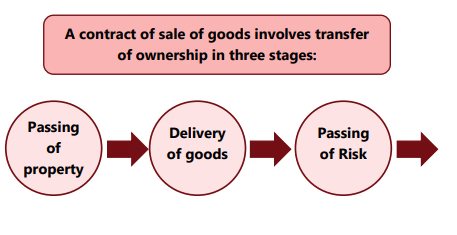
The sale of goods involves the transfer of ownership from the seller to the buyer. It is crucial to determine the exact moment when this ownership passes from the seller to the buyer.
Importance of the Time of Transfer
The general principle is that risk passes with property. If goods are lost or damaged, the owner at the time of loss or damage bears the burden. If goods are damaged by a third party, the owner has the right to take action. The seller can only sue for the price once the property has been transferred to the buyer.
Try yourself:
When does ownership of goods pass from the seller to the buyer in a sale transaction?
- A.At the time of payment
- B.Upon delivery of the goods
- C.When the buyer expresses interest in purchasing the goods
- D.After the seller issues an invoice
Passing of Property (Sections 18 – 26)
Passing of property means the transfer of ownership in goods from seller to buyer. When property passes, the risk prima facie passes with it, though parties may agree otherwise. The rules for determining when property passes depend mainly on:
- Identification (ascertainment) of goods: Under Section 18, in a contract for sale of unascertained or future goods, property cannot pass until the goods are ascertained or appropriated to the contract.
- Intention of the parties: Under Section 19(1), property passes when the parties intend it to pass. Section 19(2) lists factors relevant to intention:
(i) the terms of the contract,
(ii) the conduct of the parties,
(iii) the circumstances of the case. - If parties have not clearly fixed the time, Sections 20–24 give default rules to determine when property passes.
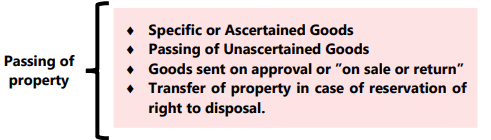
A. Passing of Property in Specific or Ascertained Goods
- Where the contract is for the sale of specific goods, property passes at the time when the parties intend it to pass. This is the general rule under Section 19(1).
- To determine the intention of the parties, regard is had to the terms of the contract, the conduct of the parties, and the circumstances surrounding the transaction (Section 19(2)).
- When there is no clear intention expressed, Sections 20–24 supply presumptions and rules to decide the time of passing property.
Stages of goods while passing of property
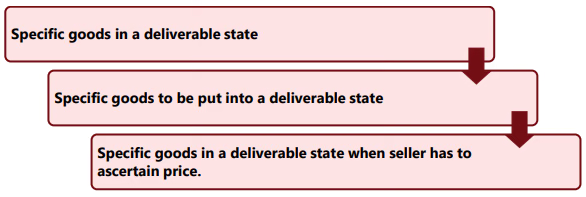
1. Specific goods in a deliverable state (Section 20)
- If there is an unconditional contract for the sale of specific goods which are already in a deliverable state, property passes to the buyer when the contract is made, regardless of whether payment or delivery is postponed.
Example 1: A customer buys a television from a shop and requests home delivery later. The television becomes the buyer’s property as soon as the contract is made, even if delivery is arranged for a later date.
MNO Limited, a supplier of electronic components, entered into a contract on August 1, 2023, with PQR Enterprises for the sale of 1000 units of microchips. The contract specifically identified the microchips by serial numbers and confirmed that they were in a deliverable state, stored in MNO Limited’s warehouse. The contract stipulated that the goods would be delivered on September 1, 2023.
On August 10, 2023, a flood occurred, damaged the warehouse and destroyed the entire stock of microchips, including the 1000 units intended for PQR Enterprises.
Examine, with reference to the provisions of the Sale of Goods Act, 1930 who shall suffer the loss? What will be your answer if the microchips are not specifically identified and marked for PQR Enterprises at the time of the contract? (4 Marks)
Ans: –
(i) According to Section 18 of the Sale of Goods Act, 1930, where there is a contract of sale for unascertained goods, the property in goods cannot pass to the buyer unless and until the goods are ascertained. The buyer can get the ownership right on the goods only when the goods are specific and ascertained.
According to section 20 of the Sale of Goods Act, 1930, where there is an unconditional contract for sale of specific goods in deliverable state, the property in the goods passes to the buyer when the contract is made, and it is immaterial whether the time of payment of price or the time of delivery of the goods, or both, is postponed. Here, the condition is goods must be ready for delivery.
In the instant case, since the microchips were specifically identified and were in a
deliverable state when the contract was formed on August 1, 2023, ownership (and risk) likely passed to PQR Enterprises on August 1, 2023.
Therefore, PQR Enterprises will suffer the loss.
Goods are not specifically identified and ascertained:
If the microchips were not specifically identified and marked for PQR Enterprises at the time of the contract, MNO Limited will suffer the loss, as the risk would not have transferred to PQR Enterprises
2. Specific goods to be put into a deliverable state (Section 21)
- Where the seller must do something to put the goods into a deliverable state (for example, perform finishing or installation), property does not pass until that act is completed and the buyer is notified.
Example 2: A laptop requiring installation of an operating system becomes the buyer’s property only after installation is completed and the buyer is informed.
X agreed to purchase 300 tons of wheat from Y out of a larger stock. X sent his men with the sacks and 150 tons of wheat were put into the sacks. Then there was a sudden fire and the entire stock was gutted. Who will bear the loss and why? (Module Q)
Ans: –
According to Section 21 of the Sales of Goods Act, 1930, if the goods are not in a deliverable state and the contract is for the sale of specific goods, the property does not pass to the buyer unless:-
(i) The seller has done his act of putting the goods in a deliverable state and
(ii) The buyer has knowledge of it.
Sometimes the seller is required to do certain acts so as to put the goods in deliverable state like packing, filling in containers etc. No property in goods passes unless such act is done and buyer knows about it.
In the given case, X has agreed to purchase 300 tons of wheat from Y out of a larger stock. X sent his men (agent) to put the wheat in the sacks. Out of 300 tones only 150 tons were put into the sacks. There was a sudden fire and the entire stock was gutted. In this case, according to the provisions of law, for 150 tons of wheat, sale has taken place. So, buyer X will be responsible to bear the loss. The loss of rest of the wheat will be that of the seller Y.
The wheat which was put in the sacks fulfils both the conditions that are
(1) The wheat is put in a deliverable state in the sacks.
(2) The buyer is presumed to have knowledge of it because the men who put the wheat in the sacks are that of the buyer.
3. Specific goods in a deliverable state, but price to be ascertained (Section 22)
- If goods are in a deliverable state but the price is to be ascertained by weighing, measuring, testing, etc., property does not pass until those operations are completed and the buyer is notified.
Example 3: Carpets delivered to a buyer, but the contract requires them to be laid beforethe property passes. If carpets are stolen before laying, the property had not passed because laying was part of the contract.
B. Unascertained Goods
For a contract of sale of unascertained or future goods, property does not pass until the goods are ascertained-that is, specifically identified and appropriated to the contract.
1. Sale of unascertained goods by description and appropriation
- Appropriation is the act of identifying goods to a specific contract with the consent of both parties. It requires: a contract for unascertained or future goods; goods conforming to contract description and quality; goods in deliverable state; and appropriation being unconditional (i.e., goods set aside or delivered to buyer, buyer’s agent, or carrier).
- Appropriation may be made by the seller or buyer with the other’s consent; consent can be express or implied and may occur before or after appropriation.
2. Delivery of goods to a carrier
- Delivery of goods to a carrier for transmission to the buyer, without reserving the right of disposal, is an unconditional appropriation of the goods to the contract and will pass property to the buyer when made.
Example 4: Issue of bill of lading in buyer’s name and its being sent to buyer indicates transfer of property to buyer.
Example 5: M orders a book to be sent by courier and requests payment by cheque. Seller sends the book by courier-this is unconditional appropriation. If the book is lost in transit, M (the buyer) is owner and bears the risk under Section 23(2).
| Discuss the essential elements regarding the sale of unascertained goods and its appropriation as per the Sale of Goods Act, 1930. (4 Marks PYQ Nov22) (MTP June 24 Series 3) (MTP June 24 Series 1) (RTP Sept 25) Ans: – Sale of unascertained goods and Appropriation: Where there is a contract for the sale of unascertained goods by description and goods of that description are in a deliverable state are unconditionally appropriated to the contract, either by the seller with the assent of the buyer or by the buyer with the assent of the seller, the property in the goods thereupon passes to the buyer. Whereas, Appropriation of goods involves selection of goods with the intention of using them in performance of the contract and with the mutual consent of the seller and the buyer. The essentials elements are: (a) There is a contract for the sale of unascertained or future goods. (b) The goods should conform to the description and quality stated in the contract. (c) The goods must be in a deliverable state. (d) The goods must be unconditionally (as distinguished from an intention to appropriate) appropriated to the contract either by delivery to the buyer or his agent or the carrier. (e) The appropriation must be made by: (i) the seller with the assent of the buyer; or (ii) the buyer with the assent of the seller. (f) The assent may be express or implied. (g) The assent may be given either before or after appropriation |
C. Goods Sent on Approval or “On Sale or Return” (Section 24)
When goods are sent on approval or “on sale or return”, property passes to the buyer in the following situations:
a. Approval or acceptance: When the buyer signifies approval or acceptance to the seller, or does some act adopting the transaction, property passes.
b. Retention without rejection: If the buyer retains the goods without rejecting them and a fixed time for return expires, or if no time was fixed but a reasonable time has passed, property passes.
c. Equivalent action: If the buyer does an act equivalent to acceptance-e.g., pledging or selling the goods-property passes.
Example 6: A tries a musical instrument at a shop on approval; when he decides to purchase it, ownership transfers.
Example 7: Jewellery given on a sale-or-return basis and then pledged by the recipient to a third party amounts to adoption of the transaction; property passes and the original owner cannot reclaim from third party-he can claim only against the intermediary.
Example 8: A sends a water motor to B on approval in March 2020; B fails to return it within a reasonable time by August 2020. Property passes and B must pay.
Sale for cash only or return: Under such terms goods remain the property of the seller until payment is completed. If buyer pledges goods prior to payment, he has no title to do so and pledge is invalid; seller may reclaim goods.
Example 9: Jewellery sent on “cash only or return” basis remains seller’s property till payment; buyer pledging such jewellery prior to payment cannot pass valid title.
Ms. Preeti owned a motor car which she handed over to Mr. Joshi on sale or return basis. After a week, Mr. Joshi pledged the motor car to Mr. Ganesh. Ms. Preeti now claims back the motor car from Mr. Ganesh. Will she succeed? Referring to the provisions of the Sale of Goods Act, 1930, decide and examine what recourse is available to Ms. Preeti. (Module Q)
Ans: –
As per the provisions of section 24 of the Sale of Goods Act, 1930, when goods are delivered to the buyer on approval or “on sale or return” or other similar terms, the property therein passes to the buyer-
(a) when the buyer signifies his approval or acceptance to the seller or does any other act adopting the transaction;
(b) if he does not signify his approval or acceptance to the seller but retains the goods without giving notice of rejection, then, if a time has been fixed for the return of the goods, on the expiration of such time, and, if no time has been fixed, on the expiration of a reasonable time; or
(c) he does something to the good which is equivalent to accepting the goods e.g. he pledges or sells the goods.
Referring to the above provisions, we can analyse the situation given in the question.
Since, Mr. Joshi, who had taken delivery of the Motor car on Sale or Return basis and pledged the motor car to Mr. Ganesh, has attracted the third condition that he has done something to the good which is equivalent to accepting the goods e.g. he pledges or sells the goods.
Therefore, the property therein (Motor car) passes to Mr. Joshi. Now in this situation, Ms. Preeti cannot claim back her Motor Car from Mr. Ganesh, but she can claim the price of the motor car from Mr. Joshi only
The buyer took delivery of 20 tables from the seller on sale or return basis without examining them. Subsequently, he sold 5 tables to his customers. The customer lodged a complaint of some defect in the tables. The buyer sought to return tables to the seller. Was the buyer entitled to return the tables to the seller under the provisions of the Sale of Goods Act, 1930? (Module Q)
Ans: –
According to Section 24 of the Sales of Goods Act, 1930, in case of delivery of goods on approval basis, the property in goods passes from seller to the buyer:-
(i) When the person to whom the goods are given either accepts them or does an act which implies adopting the transaction.
(ii) When the person to whom the goods are given retains the goods without giving his approval or giving notice of rejection beyond the time fixed for the return of goods and in case no time is fixed after the lapse of reasonable time.
In the given case, seller has delivered 20 tables to the buyer on sale or return basis. Buyer received the tables without examining them. Out of these 20 tables, he sold 5 tables to his customer. It implies that he has accepted 5 tables out of 20.
When the buyer received the complaint of some defect in the tables, he wanted to return all the tables to the seller. According to the provisions of law he is entitled to return only 15 tables to the seller and not those 5 tables which he has already sold to his customer. These 5 tables are already accepted by him so the buyer becomes liable under the doctrine of “Caveat Emptor”
A delivered a horse to B on sale and return basis. The agreement provided that B should try the horse for 8 days and return, if he did not like the horse. On the third day the horse died without the fault of B. A file a suit against B for the recovery of price. Can he recover the price? (Module Q)
Ans: –
A delivered the horse to B on sale or return basis. It was decided between them that B will try the horse for 8 days and in case he does not like it, he will return the horse to the owner A.
But on the third day the horse died without any fault of B. The time given by the seller A to the buyer B has not expired yet. Therefore, the ownership of the horse still belongs to the seller A. B will be considered as the owner of the horse only when B does not return the horse to A within stipulated time of 8 days.
The suit filed by A for the recovery of price from B is invalid and he cannot recover the price from B. [Section 24].
Had the horse died after the expiry of given time i.e. 8 days, then B would have been held liable (if the horse was still with him) but not before that time period
Ashok, a trader, delivered a camera to Mangesh on ‘sale or return’ basis. Mangesh delivers the camera to Rahul on the terms of ‘sale for cash only or return’. Afterward, Rahul delivered it to Vishal on a ‘sale or return’ basis without paying cash to Mangesh. The camera, which was in the possession of Vishal was lost by theft though he exercised due care for its safety. Referring to the provisions of the Sale of Goods Act, 1930, analyse the situation and advise, whether Mangesh, Rahul or Vishal are, jointly or severally, liable to pay the price of the camera to Ashok. (4 Marks PYQ Sept 24) (MTP Jan 25 Series 1)
Ans: –
As per the provisions of section 24 of the Sale of Goods Act, 1930, when goods are delivered to the buyer on approval or “on sale or return” or other similar terms, the property therein passes to the buyer when he does something to the good which is equivalent to accepting the goods e.g. he pledges or sells the goods.
Referring to the above provisions, we can analyse the situation given in the question.
Since, Mangesh, who had taken delivery of the camera on Sale or Return basis and delivers the same to Rahul on sale for cash only or return, has attracted the third condition that he has done something to the good which is equivalent to accepting the goods e.g. he pledges or sells the goods. Therefore, the property therein (Camera) passes to Mangesh.
Now, Rahul delivered it to Vishal on a sale or return without paying cash to Mangesh. Since Rahul did not pay cash and had not exercised the option to purchase, ownership of the camera did not pass to Rahul. Therefore, Rahul is not liable to pay the price of the camera either.
Since Vishal did not accept the goods and the camera was lost by theft (despite his due care), Vishal is not liable for the price of the camera as ownership had not passed to him.
Therefore, Mangesh is solely liable to pay the price of the camera to Ashok, as he accepted the camera on a “sale or return” basis and did not return it within a reasonable time
J, a wholesaler of premium Basmati rice delivered on approval 100 bags of rice of 10 kg each to a local retailer, on sale or returnable basis within a month of delivery. The next day the retailer sold 5 bags of rice to a regular customer K. A week later K informed the retailer that the quality of rice was not as per the price.
The retailer now wants to return all the rice bags to J, including the 4 bags not used by K. Can the retailer do so?
Also briefly describe the provisions underlying in this context of the Sale of Goods Act, 1930, (7 Marks PYQ June 24) (RTP Jan 25) (MTP Jan 25 Series 2)
Ans: –
According to Section 24 of the Sales of Goods Act, 1930, in case of delivery of goods on approval basis, the property in goods passes from seller to the buyer:-
(i) When the person to whom the goods are given either accepts them or does an act which implies adopting the transaction.
(ii) When the person to whom the goods are given retains the goods without giving his approval or giving notice of rejection beyond the time fixed for the return of goods and in case no time is fixed after the lapse of reasonable time.
In the given case, J (seller) has delivered on approval 100 bags of rice of 10 kg each to local retailer (buyer) on sale or returnable basis within a month of delivery. Out of these 100 bags, the local retailer sold 5 bags to K (customer). It implies that the local retailer has accepted 5 bags out of 100.
A week later, local retailer received the complaint of some defect in the rice bags, so, he wanted to return all the bags to the J (seller).
According to the above provisions, the local retailer is entitled to return only 95 bags to the J (seller) and not those 4 bags which are not used by K. Because, as per clause (i) above, the local retailer has already sold 5 bags, signifying that he has done an act which implies adopting the transaction relating to those 5 bags.
Samuel purchased a Television set from Arun, the owner of Gada Electronics, on the condition that for the first three days he will check its quality and if satisfied he will pay for that otherwise he will return the Television set. On the second day, the Television set was spoiled due to an earthquake. Arun demands the price of Television set from Samuel. Whether Samuel is liable to pay the price under the Sale of Goods Act, 1930? Who will ultimately bear the loss? (RTP Sept 24) (RTP June 24)
Ans: –
According to Section 24 of the Sale of Goods Act, 1930, “When the goods are delivered to the buyer on approval or on sale or return or other similar terms, the property passes to the buyer:
(i) when he signifies his approval or acceptance to the seller,
(ii) when he does any other act adopting the transaction, and
(iii) if he does not signify his approval or acceptance to the seller but retains goods beyond a reasonable time”.
Further, as per Section 8, where there is an agreement to sell specific goods, and subsequently the goods without any fault on the part of the seller or buyer perish or become so damaged as no longer to answer to their description in the agreement before the risk passes to the buyer, the agreement is thereby avoided.
Samuel purchases a Television set from Arun, the owner of Gada Electronics, on sale or approval for three days. Before Samuel could take any decision, the Television set spoiled due to earthquake.
According to the above provisions and fact, the property has not been passed to Samuel i.e buyer as no condition of Section 24 is satisfied. Hence, risk is not passed to the buyer and the agreement is thereby avoided. Samuel is not liable to pay the price. The loss finally should be borne by Seller, Mr. Arun.
D. Reservation of Right of Disposal (Section 25)
- Section 25 recognises that the seller may reserve the right of disposal (i.e., conditionally appropriate goods) even where goods are delivered. In such cases, property does not pass until the condition is satisfied.
- Examples of presumed reservation include when a bill of lading or railway receipt is made deliverable to the order of the seller, or when the seller sends a bill of exchange for price along with documents of title to secure acceptance/payment; until the buyer accepts/pays and returns the document, property does not pass.
Example 10: Seller instructs driver not to deliver furniture until payment is made. Property passes only when payment is received.
Risk Prima Facie Passes with Property (Section 26)
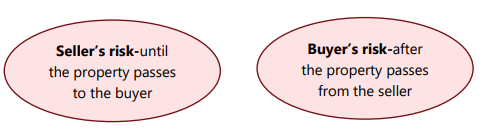
- Unless agreed otherwise, goods are at the seller’s risk until property passes to the buyer; after property passes goods are at the buyer’s risk, even if delivery has not been completed (Section 26).
- If delivery is delayed because of the default of either party, the goods are at the risk of the party in fault for losses that would not have occurred but for that default.
- Parties may contract that risk passes at a different time from property: e.g., “risk passes on shipment” or “risk remains with seller until delivery”.
Seller’s risk: Until property passes. Buyer’s risk: From when property passes.
Example 11: At an auction, when the auctioneer accepts a bid by striking the hammer, the sale becomes complete only on acceptance. If the auctioneer damages the painting accidentally while accepting, the loss is borne by the seller because ownership had not passed to the buyer before acceptance.
Qualifications to the rule
i. Delayed delivery: If delivery is delayed due to default of seller or buyer, the party at fault bears the risk for losses caused by that default.
ii. Duties as bailee: Even where risk has passed, the duties and liabilities of the seller or buyer acting as a bailee continue; they must take reasonable care of the goods.
Example 12: B accepts part delivery of cotton but defaults on accepting remaining bales which later become unfit; loss is borne by the buyer. The bailee duties (care of goods) are unaffected by passing of risk.
Parties may agree that the risk will pass at a different time than the property; such an agreement will govern.
Mr. S agreed to purchase 100 bales of cotton from V, out of his large stock and sent his men to take delivery of the goods. They could pack only 60 bales. Later on, there was an accidental fire and the entire stock was destroyed including 60 bales that were already packed. Referring to the provisions of the Sale of Goods Act, 1930 explain as to who will bear the loss and to what extent? (Module Q)
Ans: –
Section 26 of the Sale of Goods Act, 1930 provides that unless otherwise agreed, the goods remain at the seller’s risk until the property therein is transferred to the buyer, but when the property therein is transferred to the buyer, the goods are at buyer’s risk whether delivery has been made or not. Further Section 18 read with Section 23 of the Act provide that in a contract for the sale of unascertained goods, no property in the goods is transferred to the buyer, unless and until the goods are ascertained. Also where there is contract for the sale of unascertained or future goods by description, the property in the goods thereupon passes to the buyer. when goods of that description are put in a deliverable state and are unconditionally appropriated to the contract, either by the seller with the assent of the buyer or by the buyer with the assent of the seller, Such assent may be express or implied.
Applying the aforesaid law to the facts of the case in hand, it is clear that Mr. S has the right to select the goods out of the bulk and he has sent his men for the same purpose.
Hence the problem can be answered based on the following two assumptions and the answer will vary accordingly.
(i) Where the bales have been selected with the consent of the buyer’s representatives:
In this case, the property in the 60 bales has been transferred to the buyer and goods have been appropriated to the contract. Thus, loss arising due to fire in case of 60 bales would be borne by Mr. S. As regards 40 bales, the loss would be borne by Mr. V, since the goods have not been identified and appropriated.
(ii) Where the bales have not been selected with the consent of buyer’s representatives:
In this case, the property in the goods has not been transferred at all and hence the loss of 100 bales would be borne by Mr. V completely.
Transfer of Title by Non-owners (Sections 27 – 30)
The general rule is encapsulated in the maxim Nemo dat quod non habet – a seller cannot pass a better title than he has. Thus, if the seller is not the owner, the buyer ordinarily does not obtain ownership. However, statute and law recognise exceptions to protect bona fide purchasers in certain situations.
Example 13: If A sells stolen goods to B, B (even if in good faith) does not get title; true owner can reclaim.
Example 14: Hirer under hire-purchase sells the vehicle; buyer obtains only the title the hirer had (no better title).
J the owner of a Fiat car wants to sell his car. For this purpose, he hand over the car to P, a mercantile agent for sale at a price not less than 50,000. The agent sells the car for 40,000 to A, who buys the car in good faith and without notice of any fraud. P misappropriated the money also. J sues A to recover the Car. Decide giving reasons whether J would succeed. (Module Q)
Ans: –
The problem in this case is based on the provisions of the Sale of Goods Act, 1930 contained in the proviso to Section 27. The proviso provides that a mercantile agent is one who in the customary course of his business, has, as such agent, authority either to sell goods, or to consign goods, for the purpose of sale, or to buy goods, or to raise money on the security of goods [Section 2(9)]. The buyer of goods from a mercantile agent, who has no authority from the principal to sell, gets a good title to the goods if the following conditions are satisfied:
(1) The agent should be in possession of the goods or documents of title to the goods with the consent of the owner.
(2) The agent should sell the goods while acting in the ordinary course of business of a mercantile agent.
(3) The buyer should act in good faith.
(4) The buyer should not have at the time of the contract of sale notice that the agent has no authority to sell.
In the instant case, P, the agent, was in the possession of the car with J’s consent for the purpose of sale. We assume the agent P acted in the ordinary course of business and sold the car to buyer A in good faith. Therefore A, the buyer obtained a good title to the car. Hence, J in this case, cannot recover the car from A.
Exceptions to the general rule
Summary Table of Key Exceptions (Sections 27-30)
| Exception | Section | Key Requirement |
| Mercantile Agent | 27 (Proviso) | Possession with consent, ordinary course of business, good faith |
| Joint Owner | 28 | Sole possession with permission, good faith |
| Voidable Contract | 29 | Possession obtained via voidable contract (not yet rescinded), good faith |
| Seller in Possession | 30(1) | Seller continues in possession after sale, good faith |
| Buyer in Possession | 30(2) | Buyer obtains possession before sale completes, good faith |
| Unpaid Seller | 54(3) | Lien/stoppage in transit exercised, good faith |
(i) Sale by a mercantile agent (Proviso to Section 27)
- A mercantile agent in possession of goods or documents of title with the owner’s consent can pass a good title to a buyer who purchases in the ordinary course of business and without notice of the agent’s lack of authority.
Example: A mercantile agent sells goods in the ordinary course; the buyer, unaware of a defect in authority, receives good title.
(ii) Sale by one of the joint owners (Section 28)
- If goods are owned jointly and one co-owner in sole possession (with consent of other co-owners) sells the goods to a buyer in good faith and without notice of lack of authority, the buyer acquires good title.
Example 15: A, B and C jointly own a TV; A (with consent) sells to P-P gets valid title.
A, B and C were joint owner of a truck and the possession of the said truck was with B. X purchased the truck from B without knowing that A and C were also owners of the truck. Decide in the light of provisions of Sales of Goods Act 1930, whether the sale between B and X is valid or not? (Module Q)
Ans: –
According to Section 28 of the Sales of Goods Act, sale by one of the several joint owners is valid if the following conditions are satisfied:-
(i) One of the several joint owners has the sole possession of them.
(ii) Possession of the goods is by the permission of the co-owners.
(iii) The buyer buys them in good faith and has not at the time of contract of sale knowledge that the seller has no authority to sell.
In the above case, A, B and C were the joint owners of the truck and the possession of the truck was with B. Now B sold the said truck to X. X without knowing this fact purchased the truck from B.
The sale between B and X is perfectly valid because Section 28 of the Sales of Goods Act provides that in case one of the several joint owners has the possession of the goods by the permission of the co-owners and if the buyer buys them in good faith without the knowledge of the fact that seller has no authority to sell, it will give rise to a valid contract of sale.
(iii) Sale by a person in possession under a voidable contract (Section 29)
- If the seller is in possession under a voidable contract (for example, obtained by fraud) and the contract has not been rescinded before the sale, an innocent purchaser for value may obtain a good title.
Example 16: X fraudulently obtains a ring from Y (voidable). Before Y rescinds, X sells to Z, innocent purchaser. Z acquires good title.
(iv) Sale by a seller in possession of goods or documents of title (Section 30(1))
- If the seller, having sold the goods, remains in possession of them or of the documents of title and then sells them to a third party who buys in good faith and without notice of the prior sale, the third party obtains a good title.
Example 17: R agrees to deliver a TV to P later, but sells same TV to S who buys in good faith; S gets a good title.
(v) Sale by a buyer in possession before property vests (Section 30(2))
- If a buyer has possession of the goods with the seller’s consent before property has passed, the buyer may sell, pledge, or otherwise dispose of the goods; a third party who obtains them in good faith and without notice acquires a good title.
Example 18: Furniture delivered subject to payment in installments; buyer sells before paying last installment. The subsequent purchaser may acquire a good title (case law: Lee v Butler).
Example 19: Hirer A under hire-purchase sells car to C; B (owner/hirer) may recover the car because A never acquired ownership, only an option to buy.
(vi) Effect of estoppel
- If the true owner, by his conduct, represents another as owner or authorised to sell and thereby induces a purchaser to buy, the true owner is estopped from denying the other’s authority; the purchaser obtains a good title by estoppel.
Example 20: A tells B in presence of C that A owns the horse; C remains silent though horse belongs to him. B buys from A. C is estopped by his silence and B obtains valid title.
(vii) Sale by an unpaid seller
- An unpaid seller who exercises rights of lien or stoppage in transit and then resells the goods under those rights will pass a good title to the subsequent bona fide purchaser.
- This is supported by provisions like Section 54(3) (relating to the rights of the unpaid seller).
(viii) Sale under provisions of other Acts
- Statutory sales by official authorities (e.g., Official Receiver, Liquidator) pass good title to purchasers.
- Purchase from finder: Under certain conditions (see Section 169, Indian Contract Act, 1872), a purchaser from a finder may obtain title.
- Sale by pawnee: A pawnee (one who holds goods as security) can sell and convey good title (see Section 176, Indian Contract Act, 1872).
Explain any six circumstances in detail in which a non-owner can convey better title to the bona fide purchaser of goods for value under the Sale of Goods Act, 1930.
Ans: –
In the following cases, a non-owner can convey better title to the bona fide purchaser of goods for value:
(1) Sale by a Mercantile Agent: A sale made by a mercantile agent of the goods for document of title to goods would pass a good title to the buyer in the following circumstances; namely;
(a) If he was in possession of the goods or documents with the consent of the owner;
(b) If the sale was made by him when acting in the ordinary course of business as a mercantile agent; and
(c) If the buyer had acted in good faith and has at the time of the contract of sale, no notice of the fact that the seller had no authority to sell (Proviso to Section 27).
Mercantile Agent means an agent having in the customary course of business as such agent has authority either to sell goods, or to consign goods for the purposes of sale, or to buy goods, or to raise money on the security of goods [Section 2(9)]
(2) Sale by one of the joint owners (Section 28): If one of several joint owners of goods has the sole possession of them by permission of the co-owners, the property in the goods is transferred to any person who buys them from such joint owner in good faith and has not at the time of the contract of sale notice that the seller has no authority to sell.
(3) Sale by a person in possession under voidable contract: A buyer would acquire a good title to the goods sold to him by a seller who had obtained possession of the goods under a contract voidable on the ground of coercion, fraud, misrepresentation or undue influence provided that the contract had not been rescinded until the time of the sale (Section 29).
(4) Sale by one who has already sold the goods but continues in possession thereof: If a person has sold goods but continues to be in possession of them or of the documents of title to them, he may sell them to a third person, and if such person obtains the delivery thereof in good faith and without notice of the previous sale, he would have good title to them, although the property in the goods had passed to the first buyer earlier. A pledge or other disposition of the goods or documents of title by the seller in possession are equally valid [Section 30(1)].
(5) Sale by buyer obtaining possession before the property in the goods has vested in him:
Where a buyer with the consent of the seller obtains possession of the goods before the property in them has passed to him, he may sell, pledge or otherwise dispose of the goods to a third person, and if such person obtains delivery of the goods in good faith and without notice of the lien or other right of the original seller in respect of the goods, he would get a good title to them [Section 30(2)].
However, a person in possession of goods under a ‘hire-purchase’ agreement which gives him only an option to buy is not covered within the section unless it amounts to a sale.
(6) Effect of Estoppel: Where the owner is estopped by the conduct from denying the seller’s authority to sell, the transferee will get a good title as against the true owner. But before a good title by estoppel can be made, it must be shown that the true owner had actively suffered or held out the other person in question as the true owner or as a person authorized to sell the goods.
(7) Sale by an unpaid seller: Where an unpaid seller who had exercised his right of lien or stoppage in transit resells the goods, the buyer acquires a good title to the goods as against the original buyer [Section 54 (3)].
(8) Sale under the provisions of other Acts:
(i) Sale by an Official Receiver or Liquidator of the Company will give the purchaser a valid title.
(ii) Purchase of goods from a finder of goods will get a valid title under circumstances [Section 169 of the Indian Contract Act, 1872]
(iii) A sale by pawnee can convey a good title to the buyer [Section 176 of the Indian Contract Act, 1872]
Try yourself:
A seller delivers goods to a carrier for transmission to the buyer without reserving the right of disposal. When does the property in the goods transfer to the buyer?
- A.At the time of delivery to the carrier
- B.At the time of payment by the buyer
- C.At the time of contract formation
- D.At the time of delivery to the buyer
“Nemo Dat Quod Non Habet” – “None can give or transfer goods what he does not himself own.” Explain the rule and state the cases in which the rule does not apply under the provisions of the Sale of Goods Act, 1930. (Module Q)
Ans: –
The term means, “none can give or transfer goods what he does not himself own”.
Exceptions to the Rule Nemo dat Quod Non Habet: Exceptions to the rule and the cases in which the Rule does not apply under the provisions of the Sale of Goods Act, 1930 are enumerated below:
(1) Sale by a Mercantile Agent: A sale made by a mercantile agent of the goods for document of title to goods would pass a good title to the buyer in the following circumstances; namely;
(a) If he was in possession of the goods or documents with the consent of the owner;
(b) If the sale was made by him when acting in the ordinary course of business as a mercantile agent; and (c) If the buyer had acted in good faith and has at the time of the contract of sale, no notice of the fact that the seller had no authority to sell (Proviso to Section 27).
Mercantile Agent means an agent having in the customary course of business as such agent authority either to sell goods, or to consign goods for the purposes of sale, or to buy goods, or to raise money on the security of goods [Section 2(9)].
(2) Sale by one of the joint owners (Section 28): If one of several joint owners of goods has the sole possession of goods by permission of the co-owners, the property in the goods is transferred to any person who buys them from such joint owner in good faith and has not at the time of the contract of sale notice that the seller has no authority to sell.
(3) Sale by a person in possession under voidable contract: A buyer would acquire a good title to the goods sold to him by a seller who had obtained possession of the goods under a contract voidable on the ground of coercion, fraud, misrepresentation or undue influence provided that the contract had not been rescinded until the time of the sale (Section 29).
(4) Sale by one who has already sold the goods but continues in possession thereof: If a person has sold goods but continues to be in possession of them or of the documents of title to them, he may sell them to a third person, and if such person obtains the delivery thereof in good faith and without notice of the previous sale, he would have good title to them, although the property in the goods had passed to the first buyer earlier. A pledge or other disposition of the goods or documents of title by the seller in possession are equally valid [Section 30(1)].
(5) Sale by buyer obtaining possession before the property in the goods has vested in him:
Where a buyer with the consent of the seller obtains possession of the goods before the property in them has passed to him, he may sell, pledge or otherwise dispose of the goods to a third person, and if such person obtains delivery of the goods in good faith and without notice of the lien or other right of the original seller in respect of the goods, he would get a good title to them [Section 30(2)].
(6) Effect of Estoppel: Where the owner is estopped by the conduct from denying the seller’s authority to sell, the transferee will get a good title as against the true owner. But before a good title by estoppel can be made, it must be shown that the true owner had actively suffered or held out the other person in question as the true owner or as a person authorized to sell the goods.
(7) Sale by an unpaid seller: Where an unpaid seller who had exercised his right of lien or stoppage in transit resells the goods, the buyer acquires a good title to the goods as against the original buyer [Section 54 (3)].
(8) Sale under the provisions of other Acts:
(i) Sale by an Official Receiver or Liquidator of the Company will give the purchaser a valid title.
(ii) Purchase of goods from a finder of goods will get a valid title under circumstances [Section 169 of the Indian Contract Act, 1872]
(iii) A sale by pawnee can convey a good title to the buyer [Section 176 of the Indian Contract Act, 1872]
X, a furniture dealer, delivered furniture to Y under an agreement of sale, whereby Y had to pay the price of the furniture in three instalments. As per the terms of the agreement, the furniture will become the property of Y on payment of the last instalment. Before Y had paid the last instalment, he sold the furniture to Z, who purchased it in good faith. X brought a suit against Z for the recovery of the furniture on the ground that Z had no title to it. Decide the case on the basis of the provisions as per the Sale of Goods Act, 1930. (4 Marks PYQ Dec 23)
Ans:-
As per section 30(2) of the Sale of Goods Act, 1930, where a buyer with the consent of the seller obtains possession of the goods before the property in them has passed to him, he may sell, pledge or otherwise dispose of the goods to a third person, and if such person obtains delivery of the goods in good faith and without notice of the lien or other right of the original seller in respect of the goods, he would get a good title to them.
In the instant case, furniture was delivered to Y under an agreement that price was to be paid in three instalments; the furniture to become property of Y on payment of third instalment.
Y sold the furniture to Z before the third instalment was paid. Here, Z acquired a good title to the furniture, since he purchased the furniture in good faith.
Hence, X will not succeed in his suit for the recovery of the furniture as Z acquired a good title of the furniture
Performance of the Contract of Sale (Sections 31 – 44)
A contract of sale is performed when the seller delivers the goods, the buyer accepts delivery, and the buyer pays the price, all in accordance with the contract terms.
Delivery: definition and importance
- Delivery means voluntary transfer of possession from one person to another (Section 2(2)). Physical handing over is not always necessary; what matters is that the buyer is enabled to exercise the rights of ownership or possession described by the contract.
- Delivery obtained by fraud or misrepresentation is not valid.
- Delivery may be to the buyer, to the buyer’s agent, or to a carrier or bailee as agreed by the parties; such delivery may be actual, symbolic, or constructive.
Types of delivery
- Actual delivery: Physical handing over of goods to the buyer or authorised agent.
- Symbolic delivery: Transfer by handing over something symbolic (e.g., keys, documents) representing the goods.
- Constructive delivery: Goods are made available in such a manner that the buyer can take possession (e.g., goods placed in a warehouse and the buyer is informed).
Duties of seller and buyer
- Under Section 31, the seller must deliver the goods and the buyer must accept and pay for them according to the contract terms.
Concurrent conditions of payment and delivery (Section 32)
- Except where agreed otherwise, delivery of goods and payment of price are concurrent conditions: the seller must be ready to deliver on receiving payment, and the buyer must be ready to pay in exchange for possession.
Rules regarding the delivery of goods
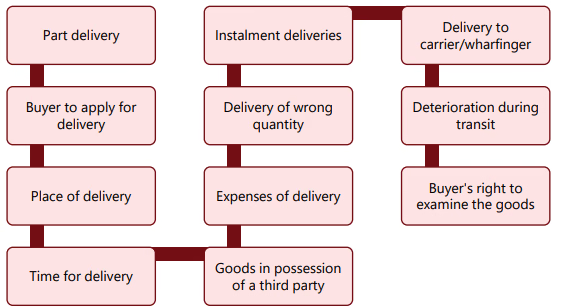
The Sale of Goods Act provides rules covering:
- Part delivery
- Buyer to apply for delivery
- Place of delivery
- Time for delivery
- Goods in possession of a third party
- Expenses of delivery
- Delivery of wrong quantity
- Instalment deliveries
- Delivery to carrier/wharfinger
- Deterioration during transit
- Buyer’s right to examine goods
(i) Delivery of goods sold (Section 33)
- Delivery may be effected by any action agreed between the parties or by acts which put the goods into the purchaser’s possession or into the possession of a person authorised to hold them on the purchaser’s behalf.
(ii) Effect of part delivery (Section 34)
- Delivery of part of the goods in fulfilment of a contract has the same effect as delivery of the whole, unless the part was delivered with intention of severing it from the whole.
Example 21: Goods lying at a wharf sold in a lot; buyer takes away part after wharfinger delivers – treated as delivery of whole.
(iii) Buyer’s right to apply for delivery (Section 35)
- Seller is not bound to deliver goods until buyer applies for delivery, unless the contract provides otherwise.
(iv) Place of delivery
- Where contract specifies, that place governs. If not specified, goods are to be delivered at the place where they are at time of sale; goods agreed to be sold are delivered at place where they are at time of agreement to sell.
(v) Time of delivery
- If no time is fixed for sending goods, seller must send them within a reasonable time (Section 36(2)).
(vi) Goods in possession of a third party (Section 36(3))
- If goods are in third party’s possession at time of sale, there is no delivery until the third party acknowledges to buyer that he holds goods on buyer’s behalf. This does not affect transfer of documents of title.
(vii) Time for tender of delivery
- Demand or tender of delivery should normally be made at a reasonable hour; what is reasonable is a question of fact (Section 36(4)).
(viii) Expenses for delivery (Section 36(5))
- Expenses incidental to putting goods into a deliverable state must be borne by seller unless contract states otherwise.
(ix) Delivery of wrong quantity (Section 37)
- Less quantity: Buyer may reject the goods; if buyer accepts the lesser quantity, he pays at contract rate for accepted quantity.
- More quantity: Buyer may accept goods included in contract and reject rest, or reject whole. If buyer accepts whole delivery he must pay contract price for whole lot.
- Mixed goods: If contracted goods mixed with other goods not in contract, buyer may accept conforming goods and reject rest or reject entire delivery.
- Provisions subject to any usage of trade, special agreement, or course of dealing.
Example 22: A agrees to sell 100 quintals of wheat to B at ₹1,000 per quintal but delivers 1,100 quintals. B may reject whole lot, accept only 100 quintals, or accept whole lot and pay contract price for all.
Explain the provisions relating to the delivery of the wrong quantity of goods as per the provisions of the Sale of Goods Act, 1930. (3 Marks PYQ Sept 24) (RTP May 25)
Ans: –
Delivery of wrong quantity [Section 37 of the Sale of Goods Act, 1930]: Where the seller delivers to the buyer a quantity of goods less than he contracted to sell, the buyer may reject them, but if the buyer accepts the goods so delivered he shall pay for them at the contract rate. [Sub-section (1)]
Where the seller delivers to the buyer a quantity of goods larger than he contracted to sell, the buyer may accept the goods included in the contract and reject the rest, or he may reject the whole. If the buyer accepts the whole of the goods so delivered, he shall pay for them at the contract rate. [Sub-section (2)]
Where the seller delivers to the buyer the goods he contracted to sell mixed with goods of a different description not included in the contract, the buyer may accept the goods which are in accordance with the contract and reject, or may reject the whole. [Sub-section (3)]
The provisions of this section are subject to any usage of trade, special agreement or course of dealing between the parties. [Sub-section (4)]
Against B’s tender, R agrees to sell and deliver 1,000 kg tomatoes @ `100 per kg which shall be delivered on 15th July, 2023. Due to the rise of the prices of tomatoes in the market, R delivered only 700 kg of tomatoes on 15th July, 2023 and agrees to deliver the balance quantity in the next month. B accepted 700 kg of tomatoes sent by R. Later, R failed to deliver the balance quantity and so B refused to pay the price of 700 kg of tomatoes to R as he had failed to fulfill the tender conditions stipulated in the contract of sale.
Can B refuse to pay R as per the provisions of the Sale of Goods Act, 1930? (2 Marks PYQ Dec 23)
Ans:-
According to Section 37(1) of the Sale of Goods Act, 1930, where the seller delivers to the buyer a quantity of goods less than he contracted to sell, the buyer may reject them, but if he accepts the goods so delivered, he shall pay for them at the contract rate.
In the instant case, R delivered 700 kg of tomatoes on 15th July, 2023 and agrees to deliver 300 kg in the next month. Later R failed to deliver the balance quantity and B (buyer) refused to pay the price of 700 kg of tomatoes.
Considering the above provisions, we can conclude that B cannot refuse to pay for 700 kg of tomatoes to R.
Important Note: The answer can also be given as per Section 34 of the Sale of Goods Act, 1930, which provides that a delivery of part of goods, in progress of the delivery of the whole has the same effect, for the purpose of passing the property in such goods, as a delivery of the whole.
In the instant case, R delivered 700 kg of tomatoes on 15th July, 2023 and agrees to deliver 300 kg in the next month. Later R failed to deliver the balance quantity and B (buyer) refused to pay the price of 700 kg of tomatoes.
Considering the above provisions, we can conclude that B cannot refuse to pay for 700 kg of tomatoes to R
(x) Instalment deliveries (Section 38)
- Unless agreed otherwise, the buyer is not bound to accept delivery by instalments. Rights and liabilities for instalment deliveries depend on the terms of the contract and the parties’ agreement.
Example 23: Sale of 100 tons of paper to be shipped in November; seller ships 80 tons in November and 20 tons in December-buyer entitled to reject whole lot (where instalment shipments are essential to contract).
(xi) Delivery to carrier (Section 39)
- Subject to contract terms, delivery to the carrier for transmission to buyer is prima facie deemed delivery to buyer.
(xii) Deterioration during transit (Section 40)
- Where goods are delivered for distant transmission, liability for deterioration necessarily incidental to transit generally falls on the buyer even if seller agreed to deliver at his own risk.
Example 24: Iron rods sent by proper vessel rusted slightly but rust did not affect merchantable quality and deterioration was not necessarily incidental to transmission; buyer was held bound to accept.
(xiii) Buyer’s right to examine the goods (Section 41)
- When goods are delivered, and the buyer has not previously examined them, the buyer is entitled to a reasonable opportunity to examine them before acceptance. Seller must allow a reasonable time for inspection unless otherwise agreed.
Rule related to acceptance of delivery of goods (Section 42)
- The buyer informs the seller of the acceptance of the goods.
- The buyer acts in a way that is inconsistent with the seller’s ownership of the goods.
- The buyer retains the goods after a reasonable time without notifying the seller of rejection.
Buyer not bound to return rejected goods (Section 43)
- Unless otherwise agreed, if the buyer refuses delivery, he is not obliged to return the goods; it suffices to inform the seller of the refusal.
Liability of buyer for neglecting or refusing delivery (Section 44)
- If the seller is ready and willing to deliver and the buyer neglects or refuses to take delivery within a reasonable time, the buyer is liable for any loss caused by such neglect or refusal and for reasonable custody costs.
- Section 44 does not affect the seller’s other rights if the buyer’s conduct amounts to repudiation of the contract.
Mr. G sold some goods to Mr. H for a certain price by issue of an invoice, but payment in respect of the same was not received on that day. The goods were packed and lying in the godown of Mr. G. The goods were inspected by H’s agent and were found to be in order. Later on, the dues of the goods were settled in cash. Just after receiving cash, Mr. G asked Mr. H that goods should be taken away from his godown to enable him to store other goods purchased by him. After one day, since Mr. H did not take delivery of the goods, Mr. G kept the goods out of the godown in an open space. Due to rain, some goods were damaged.
Referring to the provisions of the Sale of Goods Act, 1930, analyse the above situation and decide who will be held responsible for the above damage. Will your answer be different if the dues were not settled in cash and are still pending? (MTP June 24 Series 2) (RTP Sept 25)
Ans: –
According to section 44 of the Sale of Goods Act, 1930, when the seller is ready and willing to deliver the goods and requests the buyer to take delivery, and the buyer does not within a reasonable time after such request take delivery of the goods, he is liable to the seller for any loss occasioned by his neglect or refusal to take delivery and also for a reasonable charge for the care and custody of the goods.
Risk of loss of goods prima facie follows the passing of property in goods. Goods remain at the seller’s risk unless the property there in is transferred to the buyer, but after transfer of property therein to the buyer, the goods are at the buyer’s risk whether delivery has been made or not.
In the given case, since Mr. G has already intimated Mr. H, that he wanted to store some other goods and thus Mr. H should take the delivery of goods kept in the godown of Mr. G, the loss of goods damaged should be borne by Mr. H.
If the price of the goods would not have settled in cash and some amount would have been pending then Mr. G will be treated as an unpaid seller and he can enforce the following rights against the goods as well as against the buyer personally:
(a) Where under a contract of sale, the property in the goods has passed to the buyer and the buyer wrongfully neglects or refuses to pay for the goods according to the terms of the contract, the seller may sue him for the price of the goods. [Section 55(1) of the Sales of Goods
Act, 1930]
(b) Where under a contract of sale the price is payable on a day certain irrespective of delivery and the buyer wrongfully neglects or refuses to pay such price, the seller may sue him for the price although the property in the goods has not passed and the goods have not been appropriated to the contract. [Section 55(2) of the Sales of Goods Act, 1930].
Leave a Reply