6.4 Current account of the balance of payments
6.4.1 Structure of the current account of the balance of payments
- components of the current account of the balance of payments:
– trade in goods
– trade in services
– primary income
– secondary income - calculation of deficits and surpluses on the current account of the balance of payments and its
component sections
6.4.2 Causes of current account deficit and surplus - reasons for current account deficits and surpluses
6.4.3 Consequences of current account deficit and surplus - impact on GDP, employment, inflation and foreign exchange rate
6.4.4 Policies to achieve balance of payments stability - the range of policies available to achieve balance of payments stability and their effectiveness
6.4 Current account of the balance of payments
The balance of payments
- The Balance of Payments (BoP) for a country is a record of all the financial transactions that occur between it and the rest of the world
- The BoP has two main sections:
- The Current Account: all transactions related to goods/services along with payments related to the transfer of income
- The Financial and Capital Account: which is not part of your syllabus
The Current Account of the balance of payments
- The Current Account is often considered to be the most important account in the BoP
- It records the net income that an economy gains from international transactions
- Money flowing into the country is recorded in the relevant account as a credit (+) and money flowing out as a debit (-)
- A current account surplus occurs when the credits (money in) are higher than the debits (money out)
- A current account deficit occurs when the credits (money in) are less than the debits (money out)
6.4.1 Structure of the current account of the balance of payments
components of the current account of the balance of payments:
– trade in goods
– trade in services
– primary income
– secondary income
Components of the current account
- The current account is made up of four main components:
1. Trade in goods (visible trade)
- This includes exports and imports of physical goods, such as machinery, food, raw materials and manufactured products
- Exports bring money into the country (credit)
- Imports involve spending on foreign goods (debit)
- This is also called visible trade
2. Trade in services (Invisible Trade)
- Includes banking, tourism, education, insurance, transport and digital services
- Services are called invisible because they are not physical products
- Like goods, exports of services are credits (money in), and imports are debits (money out)
3. Primary income
- This refers to income earned from investments and employment abroad
- Credits come from UK citizens or firms earning income from overseas (e.g., interest, profits, wages, dividends)
- Debits are payments sent abroad from the UK (e.g., profits made by foreign companies in the UK)
- This is often called net primary income (credits – debits)
4. Secondary income (Current transfers)
- These are transfers of money where nothing is received in return
- Includes foreign aid, remittances, EU contributions (or similar) and payments to international organisations
- Credits are transfers received by the UK
- Debits are transfers the UK makes to other countries
- Also known as net secondary income
calculation of deficits and surpluses on the current account of the balance of payments and its component sections
The UK current account balance for 2017
| Component | 2017 |
|---|---|
| A. Net trade in goods (exports – imports) | £-32.9bn |
| B. Net trade in services (exports – imports) | £27.9bn |
| C. Sub-total trade in goods/services (A+B) | £-5bn |
| D. Net income (interest, profits and dividends) | £-2.1bn |
| E. Current transfers | £-3.6bn |
| Total Current Account Balance (C+D+E) | £-10.7bn |
| Current Account as a % of GDP | 3.7% |
- The overall current account is calculated as:
Net trade in goods + net trade in services + net primary income + net secondary income
Example
Current Account calculations
The table shows a selection of economic data for a country.
| Data | Value in Euros (€,000m) |
|---|---|
| Primary income (net income transfers) | 150 |
| Secondary income (net current transfers) | -50 |
| Value of exported goods | 100 |
| Value of exported services | 75 |
| Value of imported goods | 40 |
| Value of imported services | 45 |
Calculate the current account balance.
Step 1: Recall the formula for calculating the current account balance
Net trade in goods + net trade in services + net income + net current transfers
Step 2: Substitute the appropriate values
Net trade in goods = (100-40) = 60
Net trade in services = (75 – 45) = 30
Net income transfers = 150
Net current transfers = — 50
Step 3: Complete the calculation
= 60 + 30 + 150 -50 = 190
Step 4: Check the units and ensure your answer uses the correct units
= € 190,000m
6.4.2 Causes of current account deficit and surplus
reasons for current account deficits and surpluses
Current account deficits and surpluses
- A current account deficit occurs when the value of imports exceeds the value of exports
- This means the country is spending more on foreign goods, services and income transfers than it is earning
Causes of current account deficits
1. Relatively low productivity
- When a country’s firms are less efficient, their production costs are higher than firms in other countries
- This makes exports more expensive and less competitive in global markets
- For example, in the early 2010s, Greece struggled with low productivity, contributing to its large trade deficit and debt crisis
2. Relatively high exchange rate
- A strong currency makes exports more expensive to foreign buyers and imports cheaper for domestic consumers
- As a result, export sales fall and imports rise
3. Relatively high inflation
- Higher domestic inflation increases the prices of goods and services to foreigners
- Exported goods become more expensive than those from countries with lower inflation, causing demand to fall
- At the same time, domestic consumers may switch to cheaper foreign goods, raising imports
- For example, in the early 2000s, Zimbabwe experienced hyperinflation, destroying export competitiveness and leading to a reliance on imported essentials
4. Rapid economic growth
- When household incomes rise quickly, people tend to buy more goods and services — including foreign products
- This increase in import spending can worsen the current account balance.
- For example, in India, periods of rapid growth have often been accompanied by widening trade deficits due to surging demand for imported oil, electronics and luxury goods
5. Non-price factors (e.g. poor quality or design)
- Even if a product is affordable, poor quality or outdated design can lead to falling export sales
- Domestic consumers may also prefer to buy higher-quality imports
- For example, some developing economies struggle to increase exports due to inconsistent product quality while importing higher-quality goods from countries like Germany or Japan
Causes of current account surpluses
- A current account surplus occurs when the value of exports exceeds the value of imports
- This suggests the country is a net earner from trade and income flows
| Relatively high productivity | Relatively low value of the country’s currency | Relatively low rate of inflation |
|---|---|---|
| High productivity decreases costsExporting firms with high productivity may find themselves at a price and cost advantage in overseas markets, which will increase competitiveness and the level of exports | Currency depreciation makes a country’s exports less expensive relative to other nationsForeign buyers increase their purchases and the level of exports risesSimilarly, currency depreciation makes imports more expensiveDomestic consumers may switch demand to locally produced products and the level of imports falls | A relatively low rate of inflation makes a country’s exports less expensive than other nationsForeign buyers increase their purchases and the level of exports rises, improving the balance on the Current Account |
6.4.3 Consequences of current account deficit and surplus
impact on GDP, employment, inflation and foreign exchange rate
Consequences of deficits and surpluses
- In the global economy, trade is a net-sum game
- The total value of global exports equals the total value of global imports
- This means that when one country runs a Current Account surplus, another must be running a Current Account deficit
Consequences of a Current Account deficit
1. Increasing unemployment
- A fall in demand for domestically produced goods and services leads to lower output
- As a result, fewer workers are needed, and unemployment rises
2. Slower economic growth or recession
- Exports are a major component of real GDP
- A sustained fall in exports can slow down economic growth or even push the economy into recession
3. Lower standards of living
- With falling growth and rising unemployment, wages may fall and households will have less to spend
- This leads to a decline in living standards
4. Increased borrowing
- Persistent deficits, especially those caused by high import levels, may force a country to borrow more to fund its spending on foreign goods and services
5. Depreciating exchange rate
- A weaker current account leads to depreciation of the national currency
- While this can eventually boost exports, it also makes imports more expensive, raising the risk of cost-push inflation
Consequences of a Current Account surplus
| Consequence | Explanation |
|---|---|
| Rising employment | Higher demand for exports increases production, creating more jobs |
| Economic growth | Export growth boosts GDP and overall national income |
| Higher living standards | More jobs and rising incomes improve household spending and well-being |
| Demand-pull inflation | Increased demand in the economy can cause prices to rise |
| Appreciating currency | Strong export performance increases demand for the currency, raising its value |
| Cheaper imports | A stronger currency makes imports more affordable, encouraging more consumption |
Case Study
The United States Current Account Deficit and Policy Response under President Trump
The United States has run a current account deficit for decades, meaning it imports more goods, services, and income than it exports.
In 2023, the US current account deficit was over $900 billion, largely due to high imports of consumer goods, energy products, and capital equipment.
This deficit has been driven by:
- Strong consumer demand for foreign goods
- A strong dollar making imports cheaper and exports more expensive
- Low national savings and high levels of government and consumer spending
- Offshoring of US production to lower-cost economies, particularly China and Mexico
Trump’s Actions
Under his first term as president (2017–2021), Donald Trump attempted to reduce the trade deficit using a mix of protectionist and nationalist economic policies under the banner of “America First”
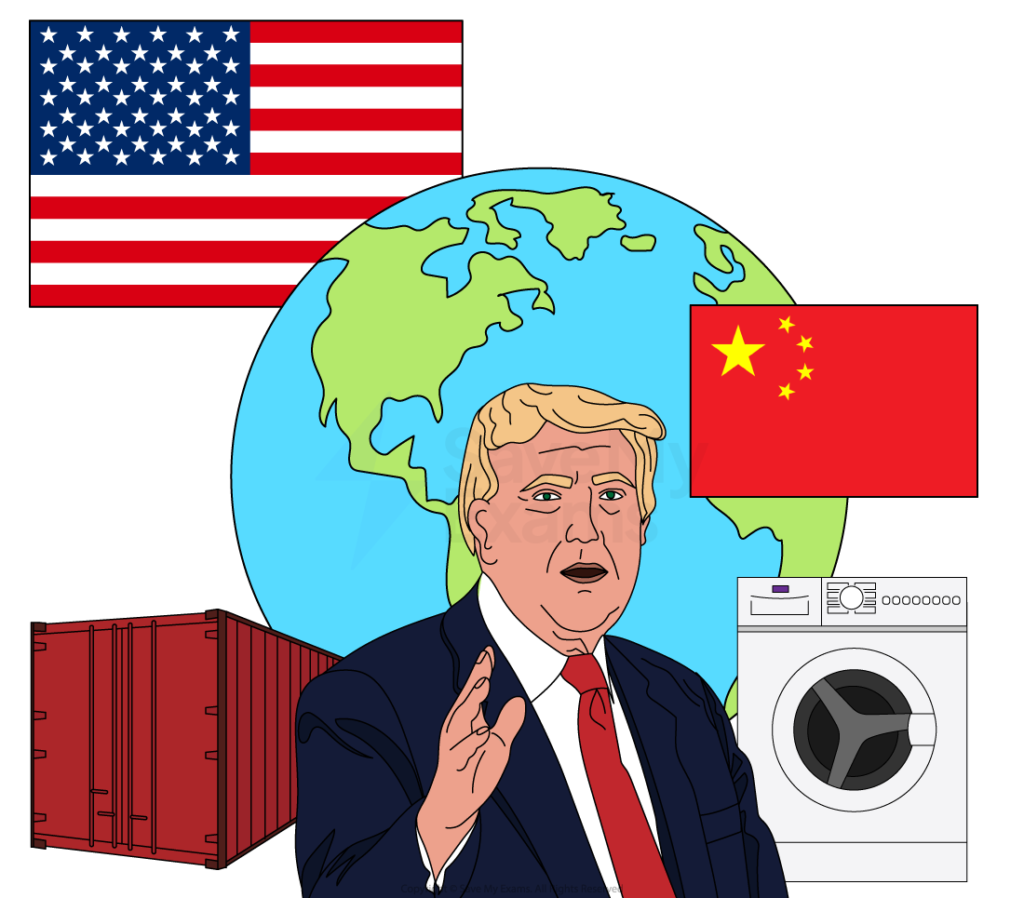
These included:
- Tariffs on Chinese imports
- Introduced tariffs on steel, aluminium, and hundreds of billions of dollars’ worth of Chinese goods to protect domestic industries and reduce imports
- Withdrawal from trade agreements
- Pulled the US out of the Trans-Pacific Partnership (TPP) and renegotiated NAFTA into the USMCA to prioritise American jobs and manufacturing
- Tax cuts and deregulation
- Reduced corporation taxes to attract domestic investment and incentivise US-based businesses to boost production
- Pressure on companies to reshore
- Publicly criticised firms outsourcing jobs and encouraged manufacturing to return to US soil
Outcome
- The trade deficit with China narrowed slightly in 2019, but the overall Current Account deficit remained large, due to strong consumer demand and higher imports from other countries like Vietnam and Mexico
- Some US manufacturing sectors (e.g. steel) saw short-term boosts in production and employment
- Tariffs led to higher prices for consumers and US firms relying on imported inputs, particularly in the automotive and technology industries
- The US dollar remained strong, keeping imports attractive and limiting export competitiveness
- There was limited long-term impact on reducing the deficit, as structural factors, such as the dollar’s global reserve status and low domestic saving, persisted
6.4.4 Policies to achieve balance of payments stability
the range of policies available to achieve balance of payments stability and their effectiveness
Policies that stabilise the current account balance
- The government have several policies (fiscal, monetary and supply-side policy) available to them in order to address a Current Account deficit or to stabilise the current account balance
They could do nothing
- Leaving it to market forces in the foreign exchange market to self-correct the deficit
| Advantage | Disadvantage |
|---|---|
| Floating exchange rates act as a self-correcting mechanismOver time a higher level of imports will end up depreciating the currency, causing imports to decrease (they are now more expensive) and exports to increase (they are now cheaper)This improves the deficit | There may be other external factors that prevent the currency from depreciatingIt may take a long time for self-correction to happen and many domestic industries may go out of business in the interimThe longer it takes to self-correct, the more firms will delay investment in the economy |
Expenditure-switching policies
- These policies aim to switch consumer expenditure from purchasing abroad to purchasing domestically
- These include
- Protectionist policies which raise the price of imports, so consumers switch to buying domestic goods
- Currency depreciation, which makes the price of imports more expensive and so consumers switch to buying domestic products
| Advantage | Disadvantage |
|---|---|
| These are often successful in changing the buying habits of consumers, switching consumption from imports to consumption of domestically produced goods and servicesThis helps improve a deficit | Any protectionist policy often leads to retaliation by trading partners.This may consist of reverse tariffs or quotas which will decrease the level of exportsThis may offset any improvement to the deficit caused by the policy |
Expenditure-reducing policies
- Measures designed to reduce total (aggregate) demand in an economy, such as contractionary fiscal or monetary policy
- These include
- Raising taxes which cause consumers to have lower disposable income and so they spend less on imports
- Raising interest rates which reduces the level of borrowing resulting in a fall in the level of imports
| Advantage | Disadvantage |
|---|---|
| Contractionary fiscal policy invariably reduces discretionary income, which leads to a fall in the demand for imported goods and improves a deficit | Contractionary fiscal policy also dampens domestic demand, which can cause output to fallWhen output falls, GDP growth slows and unemployment may increase |
Supply-side policies
- These aim to improve the quantity and quality of the factors of production, thereby raising potential output
- Investment in education which raises productivity making exports cheaper and more attractive
- Investment in infrastructure which lowers costs for firms making exports cheaper and more attractive
| Advantage | Disadvantage |
|---|---|
| Improves the quality of products and lowers the costs of production.Both of these factors help the level of exports to increase, thus reducing the deficit | These policies tend to be long-term policies so the benefits may not be seen for some timeThey usually involve government spending in the form of subsidies and this always carries an opportunity cost |
Remember
The terms ‘expenditure switching’ and ‘expenditure reducing’ are not in your syllabus. They have been included as they clearly explain the intention of any fiscal, monetary or supply-side policy used to address imbalances in the current account. The policies aim to switch expenditure away from imports or to reduce expenditure on imports – both of which will help to lower any current account deficit.