An introduction to the skills
- The IGCSE Economics exams test three key skills:
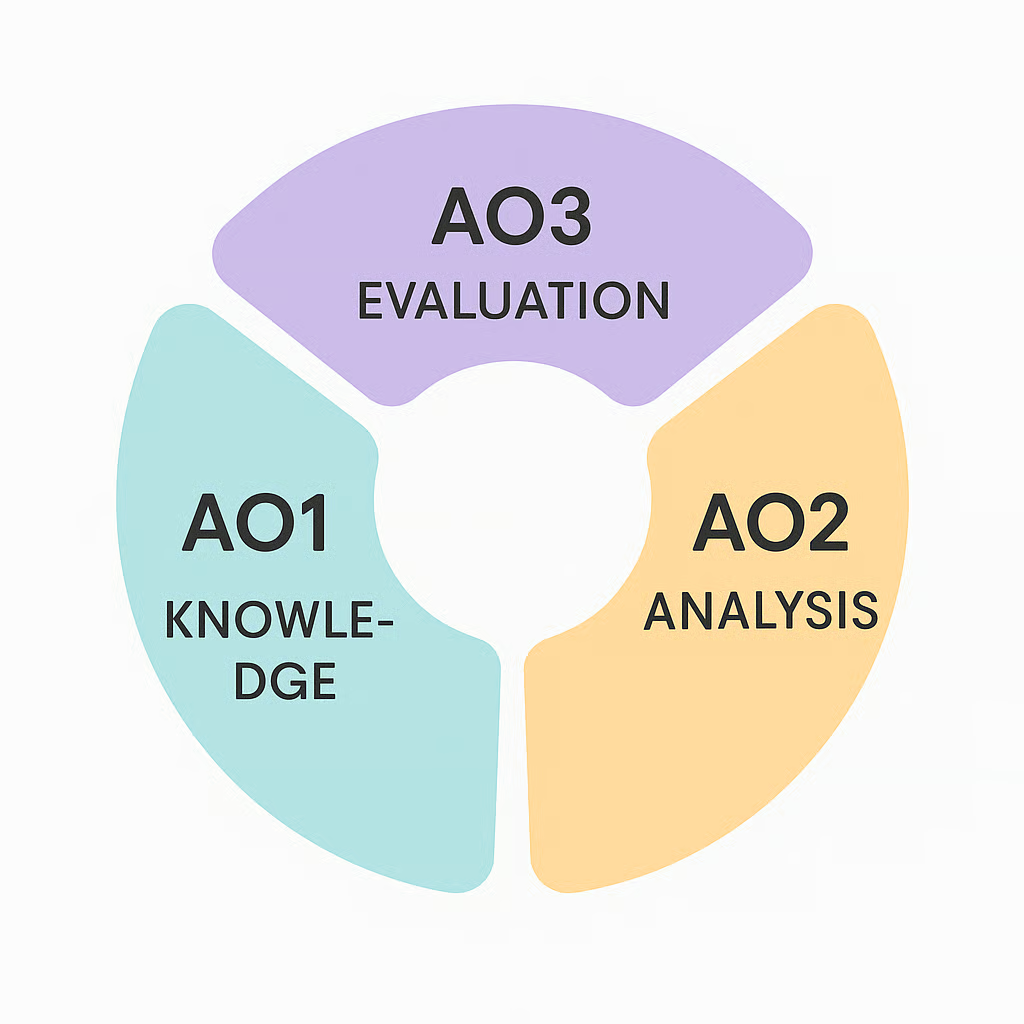
- You will use these skills across both papers, but they are most heavily rewarded in Paper 2, where written explanations, diagrams and data analysis are required
- The exams assess your ability to:
- Recall definitions and core economic concepts
- Apply concepts to real-world contexts
- Analyse diagrams, tables and written scenarios
- Perform simple calculations
- Explain cause–effect relationships
- Make reasoned, balanced economic judgements
- Each of these skills must be demonstrated clearly and separately in longer answers
AO1 Knowledge and Understanding
- AO1 is the foundation of every Economics question
- To score well in other skills, AO1 must be secure
- You gain AO1 marks for:
- Recognising, recalling and stating key economics terms
- Giving precise definitions (e.g., opportunity cost, inflation, PED)
- Identifying characteristics, causes, features or effects
- Selecting the correct formula for a calculation
- Drawing accurate, fully labelled diagrams
- Using appropriate terminology (scarcity, equilibrium, elasticity, productivity etc)
- Economic diagrams fall under AO1 only when they are drawn and labelled correctly
Worked Example
Define opportunity cost
“Opportunity cost is the next best alternative foregone when a choice is made.”
- “Next best alternative”
- “Foregone”
Both elements must be present for full AO1 marks
AO2 Analysis
- AO2 tests your ability to use economic concepts to explain real-world situations, and to show cause-effect relationships
- AO2 is the skill used most frequently in 4-mark and 6-mark questions
- You gain AO2 analysis marks for:
- Making developed explanations rather than simple statements
- Showing chains of reasoning (“because… therefore… leading to…”)
- Applying economics to:
- data extracts
- context paragraphs
- diagrams
- Using diagrams to support an explanation (e.g., explaining why a curve shifts)
- Interpreting data from tables, charts or numerical information
- Explaining why an event occurs or how one variable affects another
Worked Example
Explain why a fall in interest rates may increase consumer spending
A strong AO2 explanation will show:
- A cause →
- A direct effect →
- A final economic impact
For example
Lower interest rates reduce the cost of borrowing for households →
this makes loans and credit more affordable → leading to higher consumer spending in the economy.
This chain of reasoning demonstrates AO2 clearly
AO2 using diagrams
- When diagrams appear in Paper 2, AO2 marks are awarded for:
- Explaining what the diagram shows
- Explaining the economic reasoning behind a shift or movement
- Linking the diagram to the context of the question
- The diagram itself is AO1, but the explanation of it is AO2
AO3 Evaluation
- AO3 is tested only in Paper 2, usually in 8-mark “Discuss” questions
- Evaluation means making:
- Judgements
- Comparisons
- Trade-offs
- Balanced reasoning
- Considerations of “it depends” factors
- Short-run vs long-run differences
- Contextual decisions
- In the official Cambridge mark scheme, AO3 is credited through “levels of response”
- In Save My Exams resources, AO3 is made clearer using the defined-mark structure – where students develop two arguments on each side
- You gain AO3 marks for:
- Considering both sides of an economic issue
- Judging which side is stronger and why
- Referencing context (where relevant)
- Recognising limitations of arguments
- Showing conditions under which a policy or outcome may change
- There is no need to write a full conclusion
Worked Example
Discuss whether an increase in income tax will reduce income inequality.
Evaluation may include points such as:
- It depends on the progressiveness of the tax system
- Effectiveness depends on how tax revenue is used
- Higher income tax may reduce incentives to work (counter-effect)
- If tax avoidance is high, inequality may not fall
- Short-run impact may differ from long-run impact
Here is an example of a ‘discuss’ response
Putting the skills together
- In most longer Paper 2 answers, you are expected to use two or more skills in the same response:
- AO1 provides the definition, diagram or basic concept
- AO2 develops explanations and shows cause–effect
- AO3 weighs arguments and makes judgements
- For example, in an 8-mark “Discuss” question:
- AO1 = the economic concepts used
- AO2 = the two developed explanations on each side
- AO3 = the balanced discussion across both sides
- Correctly combining the skills leads to full marks
Leave a Reply