6.3 Foreign exchange rates
6.3.1 Definition of foreign exchange rate
6.3.2 Reasons for buying and selling foreign currencies
- trade in goods and services
- speculation
- government intervention in currency markets
- payment of profit, interest and dividends between countries
- workers’ remittances
- investment in capital goods between countries
6.3.3 Determination of foreign exchange rate in foreign exchange market - definitions of floating exchange rate, appreciation and depreciation
- the demand for and supply of a currency
- the determination of the equilibrium foreign exchange rate
- causes of foreign exchange rate fluctuations
– changes in demand for exports and imports
– changes in the interest rate
– speculation
6.3.4 Consequences of changes in foreign exchange rates - effects of changes in foreign exchange rates on prices and demand for exports and imports
6.3 Foreign exchange rates
6.3.1 Definition of foreign exchange rate
An exchange rate is the price of one currency in terms of another e.g. £1 = €1.18
International currencies are essentially products that can be bought and sold on the foreign exchange market (forex)
Exchange rates are important because they determine how much of a foreign currency you can get when you exchange your own currency — which affects trade, investment, tourism and international finance
6.3.2 Reasons for buying and selling foreign currencies
Reasons for buying and selling foreign currencies
- Countries, businesses and individuals buy and sell foreign currencies for many reasons
- The demand and supply of different currencies in the foreign exchange market is influenced by the following:
1. Trade in goods and services
- Importers need to buy foreign currencies to pay for goods and services from other countries
- Exporters, on the other hand, often receive payment in foreign currencies and exchange them into their own currency
2. Speculation
- Currency traders (speculators) buy and sell currencies to make a profit from changes in exchange rates.
- For example, if a trader expects the euro to rise in value, they might buy euros now and sell them later at a higher rate
3. Government intervention
- Governments and central banks may buy or sell their own currency to influence its value
- This is called exchange rate intervention and is often done to help control inflation, support exports, or maintain economic stability
4. Profit, interest and dividend payments
- When businesses or investors earn profits, interest, or dividends from other countries, they often need to convert the foreign currency earnings into their own currency
5. Workers’ remittances
- Many people work in foreign countries and send money home to their families (remittances)
- These remittances involve converting the worker’s earnings from the currency they are paid in into the home country’s currency
6. Investment in capital goods
- Firms and governments may invest in machinery, buildings, or infrastructure from other countries
- To do this, they need to buy the seller’s currency, which increases demand in the foreign exchange market
6.3.3 Determination of foreign exchange rate in foreign exchange market
definitions of floating exchange rate, appreciation and depreciation
- A floating exchange rate is one that is determined by the forces of demand and supply in the foreign exchange market, without direct government or central bank control
- Appreciation occurs when the value of a currency rises compared to another currency in a floating system (e.g. £1 = $1.25 → £1 = $1.35)
- A depreciation occurs when the value of a currency falls compared to another currency in a floating system (e.g. £1 = $1.25 → £1 = $1.10)
the demand for and supply of a currency
the determination of the equilibrium foreign exchange rate
Determination of the foreign exchange rate
- Different currencies can be bought and sold, just like any other product
- The equilibrium exchange rate is where the quantity of a currency demanded equals the quantity supplied
- At this rate, the market is in balance — there is no shortage or surplus of the currency
- If demand increases or supply decreases, the currency appreciates
- If demand decreases or supply increases, the currency depreciates
Demand for a currency comes from:
- Foreigners buying the country’s exports
- Tourists visiting the country
- Foreign investors buying assets, shares or property
- Speculators who expect the currency to appreciate
The supply of a currency increases when:
- Citizens import more foreign goods and services
- Tourists travel abroad and need foreign currency
- Investors send money abroad
- Speculators sell the currency expecting it to fall in value
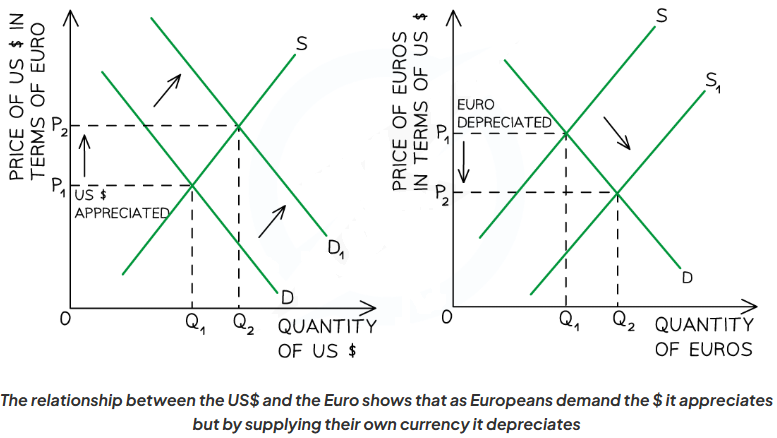
Diagram analysis
- The Euro/US$ market is shown by two market diagrams – one for the USD market on the left and one for the Euro market on the right
- The initial exchange rate equilibrium is found at P1Q1 in both markets
- When Europeans visit the USA, they demand US$ and supply Euros
- The increased demand for the US$ shifts the demand curve to the right, which results in the value of the $ appreciating from P1 → P2 in the USD market and a new market equilibrium forms at P2Q2
- The increased supply of the Euro shifts the supply curve to the right which results in the value of the Euro depreciating from P1 → P2 and a new market equilibrium forms at P2Q2
causes of foreign exchange rate fluctuations
– changes in demand for exports and imports
– changes in the interest rate
– speculation
Causes of foreign exchange rate fluctuations
- Several factors cause exchange rates to change. Three of the most common include:
| Cause | Explanation |
|---|---|
| Changes in demand for exports and imports | If a country’s exports rise, demand for its currency increases, causing appreciationIf imports rise, more of the home currency is sold to buy foreign currency, leading to depreciation |
| Changes in interest rates | Higher interest ratesattract foreign savers and investors, increasing demand for the currency and causing it to appreciateLower interest rates tend to reduce demand and cause depreciation |
| Speculation | If traders believe a currency will rise in value, they buy more of it, which increases demand and causes appreciationIf they expect it to fall, they sell the currency, increasing supply and causing depreciation |
6.3.4 Consequences of changes in foreign exchange rates
effects of changes in foreign exchange rates on prices and demand for exports and imports
What happens when exchange rates change?
A change in the exchange rate affects the relative price of domestic and foreign goods. This influences how much consumers and firms buy and sell internationally.
- If the currency appreciates (gets stronger), exports become more expensive for other countries, and imports become cheaper for domestic consumers
- If the currency depreciates (gets weaker), exports become cheaper, and imports become more expensive
Effects of currency appreciation
| Impact Area | Effect of appreciation |
|---|---|
| Exports | Become more expensive to foreigners → demand falls |
| Imports | Become cheaper → demand rises for foreign goods |
| Domestic firms | Exporters may lose customers; less revenue from overseas sales |
| Consumers | Benefit from cheaper imported goods and foreign travel |
| Inflation | Likely to fall as imported goods are cheaper and reduce cost pressures |
| Balance of Payments | May worsen if exports fall and imports rise, increasing the Current Account deficit |
Effects of currency depreciation
| Impact area | Effect of depreciation |
|---|---|
| Exports | Become cheaper to foreigners → demand increases |
| Imports | Become more expensive → demand falls for foreign goods |
| Domestic firms | Exporters benefit from higher sales → more output and possibly more jobs |
| Consumers | Face higher prices for imported goods such as electronics and fuel |
| Inflation | Likely to rise as cost of imported goods and raw materials increases |
| Balance of Payments | May improve if exports rise and imports fall, reducing the Current Account deficit |
Case Study
The UK Pound Depreciation After the 2016 Brexit Vote
In June 2016, the UK voted to leave the European Union (Brexit). As a result, there was major uncertainty in financial markets, and the value of the British pound (GBP) fell sharply against other major currencies.
- Before the referendum: £1 ≈ $1.45
- After the vote: £1 fell to ≈ $1.20 — a 17% depreciation
This depreciation affected trade, consumer prices, and the wider economy.
Impact
The weaker pound had the following effects:
- Exports became cheaper for foreign buyers
- British-made goods and services were more affordable abroad
- Imports became more expensive
- The UK had to pay more for imported products like fuel, food, and electronics
- UK firms saw a rise in overseas demand but also higher input costs for imported raw materials
- Consumers in the UK faced rising prices for everyday items due to more expensive imports
Macroeconomic result
- UK exporters benefited, especially in manufacturing and tourism, as foreign customers took advantage of favourable exchange rates
- Inflation rose in 2017, peaking at 3%, partly due to the higher import costs
- The Current Account deficit narrowed slightly, helped by stronger exports and weaker import growth
- Consumers faced reduced purchasing power, especially for imported goods, leading to pressure on real incomes and the standard of living
Leave a Reply