6.2 Globalisation and trade restrictions
6.2.1 Definition of globalisation
6.2.2 Causes and consequences of changes in globalisation
- causes of changes in globalisation:
– changes in trade restrictions
– changes in transport costs
– changes in communication costs
– movement of multinational companies (MNCs) - effects of changes in globalisation on:
– international trade
– competition
– the environment
– migration
– income distribution
– economic development
6.2.3 Role of multinational companies (MNCs) - MNCs and their advantages and disadvantages to host countries and home countries
6.2.4 Types of trade restrictions / methods of protection - tariffs
- import quotas
- subsidies
- embargoes
6.2.5 Reasons for trade restrictions
- protect infant (sunrise) industries
- protect declining (sunset) industries
- protect strategic industries
- avoid dumping
- reduce a deficit on the current account of the balance of payments
- raise tax revenue
- restrict the import of demerit goods
- promote environmental sustainability
6.2.6 Consequences of trade restrictions - impact of trade restrictions on the home country and its trading partners
- advantages and disadvantages of restricting free trade
6.2.1 Definition of globalisation
Globalisation is a process of interaction and integration among the people, companies, and governments of different nations, a process driven by international trade and investment and aided by information technology [definition by: www.globalization101.org)
What is globalisation?
- Globalisation is the economic integration of different countries through increasing freedoms in the cross-border movement of people, goods and services, technology and finance
- Globalisation has been increasing for thousands of years – it is not a new phenomenon
- This integration of global economies has impacted national cultures, spread ideas, speeded up industrialisation in developing nations and led to de-industrialisation in developed nations
- Improvements in technology and the speed of global connections have exponentially increased the level of interdependence between nations in the past 50 years
- Consumers now source products globally recognising global brands wherever they travel
6.2.2 Causes and consequences of changes in globalisation
Causes of changes in globalisation
| Cause | Explanation | Effect on globalisation |
|---|---|---|
| Changes in trade restrictions | When governments reduce tariffs, quotas, or trade bans, international trade becomes easier | Encourages more trade and global connections |
| Changes in transport costs | Improvements in shipping, air travel and logistics lower the cost of moving goods between countries | Makes global trade faster and more affordable |
| Changes in communication costs | The internet, mobile phones and digital platforms make it easier to manage and expand international trade | Speeds up decision-making and supports global trade |
| Movement of MNCs | Multinational companies expand to new countries, setting up production and creating global supply chains | Spreads economic activity across the world |
The effects of changes in globalisation
1. International trade
- Trade increases as countries buy and sell more with each other
- Greater specialisation and exchange of goods and services
- Some domestic industries may struggle with foreign competition and domestic unemployment may actually increase
2. Competition
- Firms compete not just locally, but globally
- This can lead to lower prices and improved quality
- However, domestic small or new firms may be pushed out of the market leading to reduced competition within the country
- This may actually lead to an increase in domestic prices
3. The environment
| Positive effects | Negative effects |
|---|---|
| Sharing of green technologies between countriesMNCs under pressure to meet global environmental standards | Increased production and transport raise carbon emissionsDeforestation, pollution and overuse of natural resources |
4. Migration
- Workers move to countries with better job opportunities
- Can help reduce unemployment in sending countries
- But may increase unemployment in the receiving country
- May create pressure on services (e.g. housing, healthcare) in receiving countries
5. Income distribution
| Advantage | Disadvantage |
|---|---|
| Jobs created in developing countries due to MNC investmentHigher wages are often paid to workers in export industries | The income gap between skilled and unskilled workers may widenWealth may concentrate in cities or with foreign-owned companies |
6. Economic development
- Countries benefit from investment, job creation and new technology
- Export-led growth helps raise GDP and living standards
- Can create long-term dependence on MNCs or vulnerable sectors
6.2.3 Role of multinational companies (MNCs)
MNCs and their advantages and disadvantages to host countries and home countries
Multinational Corporations (MNCs)
- A multinational corporation is a business that has production facilities in two or more countries, e.g., Apple.
- Globalisation has made it easier for firms to do business on a global scale and the number and size of MNCs continues to increase
- There are advantages and disadvantages linked to the economic activity of MNCs, both in their home country and in their host country
Advantages of MNCs
| Advantage | Impact on home country | Impact on host country |
|---|---|---|
| More profit | MNCs earn profits from their operations abroad and often send this money back home, helping the home economy | Host countries get some benefit if profits are reinvested locally, but often lose some income |
| More markets | Home country businesses can sell to new customers abroad, growing bigger and stronger | Host countries get more product choices and access to new technologies |
| Lower costs | MNCs can produce goods more cheaply abroad and offer lower prices at home | Host countries may benefit from cheaper production and local job creation |
| Risk reduction | MNCs can survive better if they sell in many countries. If sales fall in one place, they can rely on others | Host countries may experience more stable job markets if MNCs stay even during global downturns |
Disadvantages of MNCs
| Disadvantage | Impact on home country | Impact on host country |
|---|---|---|
| Job losses | Some jobs move abroad where production is cheaper, leading to unemployment at home | Host countries may become too dependent on MNCs for jobs. If an MNC leaves, many people could lose their jobs |
| Poor working conditions | MNCs may be criticised at home for allowing bad working conditions abroad | Workers in host countries may face low wages and poor conditions |
| Unfair power imbalance | MNCs might pressure home governments for favourable rules | In host countries, MNCs might influence politics and gain too much control |
| Damage to environment | MNCs can be blamed for pollution caused in host countries | Host countries might suffer from environmental damage if rules are weak |
6.2.4 Types of trade restrictions / methods of protection: tariffs, import quotas, subsidies, embargoes
Reasons for Trade Restrictions
Why do countries restrict trade?
- Free trade aims to maximise global output through national specialisation
- However, there are numerous reasons why countries would seek to limit free trade in order to protect themselves from certain outcomes
- The restriction of trade is called protectionism and may take the form of:
- Import tariffs
- Export subsidies
- The use of quotas
- Trade embargoes
- Trading partners may retaliate to any methods of protectionism and they should be carefully considered before any implementation
Reasons for protectionism
| Reason | Explanation |
|---|---|
| Protect infant (sunrise) industries | New industries may need protection from foreign competition until they become efficient and competitive.Example: A developing country supporting its growing solar panel sector |
| Protect declining (sunset) industries | Old industries that are shrinking may be protected to slow down job losses and help manage transition.Example: Coal mining in some countries |
| Protect strategic industries | Essential sectors (like food, energy and defence) are protected to maintain national securityExample: Limiting foreign control of telecoms or arms production |
| Avoid dumping | Dumping is when foreign producers sell goods below cost to gain market shareRestrictions help protect domestic firms from unfair competition |
| Reduce current account deficits | Reducing imports can help improve the balance of payments by reducing the money flowing out of the country |
| Raise tax revenue | Tariffs on imports generate revenue for governments, which is especially useful in countries with weak tax systems |
| Restrict demerit goods | Importing goods like alcohol or tobacco may be restricted to reduce harm to public health |
| Promote environmental sustainability | Restrictions can be placed on goods that damage the environment or are produced in harmful waysExample: Limiting imports from deforestation-linked supply chains |
Consequences of trade restrictions
Impact on trading partners
- Countries affected by the restrictions may lose export markets
- Tensions may increase, possibly leading to trade wars
- Can reduce income for producers and lead to job losses abroad
- Might encourage affected countries to form alternative trade agreements, leading to a loss of future exports
Impact on the home country
| Advantages | Disadvantages |
|---|---|
| Protects local jobs and industriesEncourages domestic productionIncreases government revenue through tariffsCan improve trade balance (fewer imports) | Consumers face higher prices and less variety as trade restrictions increase import costsDomestic firms may become less efficient without competitionCan provoke retaliation from other countriesSlower innovation and limited access to better technology |
Types of Trade Restrictions (Cambridge (CIE) IGCSE Economics): Revision Note
Exam code: 0455 & 0987


Written by: Steve Vorster
Reviewed by: Lisa Eades
Updated on 19 August 2025
1. Tariffs
- A tariff is a tax on imported goods or services (customs duty)
- With the price of imports higher, domestic firms find it easier to compete and increase their market share as consumers switch from buying imports to buying domestically produced goods and services
- Less efficient domestic firms are now producing at the expense of more efficient international firms
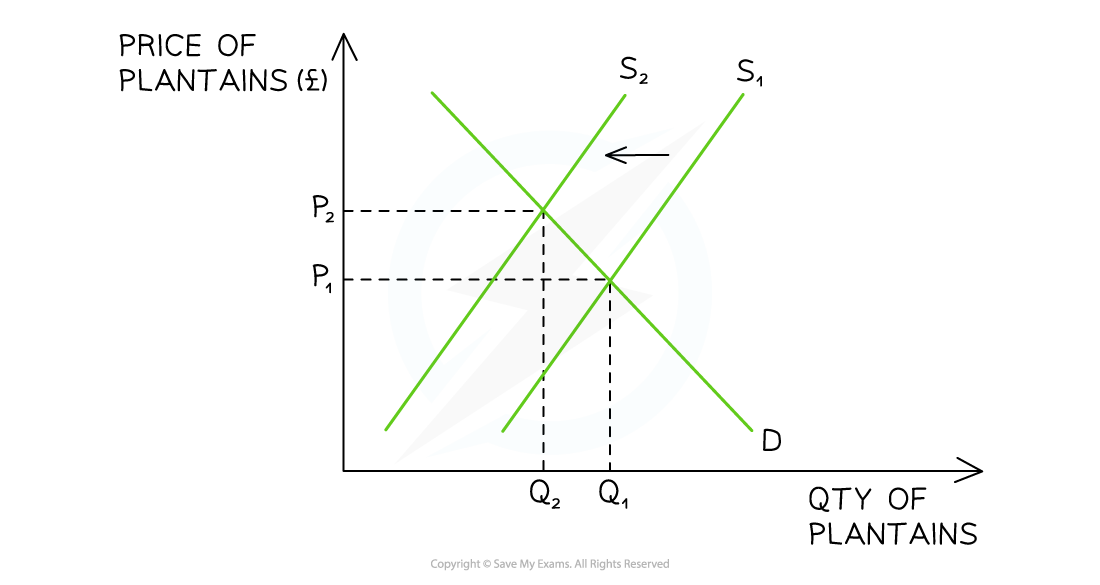
Diagram analysis
- The pre-tariff market equilibrium for plantains is seen at P1Q1
- After the tariff is imposed, costs of production for domestic firms increase (as they pay the tariff when the plantains enter the country) – the supply curve shifts fromS1 → S2
- The new market equilibrium is seen at P2Q2
Evaluating the use of tariffs to protect domestic firms
- Tariffs are one of the most widely used forms of protectionism and their impact on different stakeholders can be evaluated
| Stakeholder | Explanation |
|---|---|
| Domestic producers supported by the tariff (e.g. local steel manufacturers) | Before the tariff, these firms struggled to compete with cheaper importsAfter the tariff, foreign goods become more expensive, allowing domestic firms to increase their output and market shareHigher demand for local production may lead to more jobs in that industry and lower unemployment |
| Domestic producers affected by higher input costs (e.g. car manufacturers using imported steel) | These producers rely on imported goods as raw materialsThe tariff raises their costs of production, which can lead to lower output, higher prices for final goods, and possibly job losses in dependent industries |
| Foreign producers | Tariffs reduce their price advantage, making them less competitive in the domestic marketExport volumes fall, reducing their revenuesFrom a global perspective, resources may now be allocated less efficiently, as more efficient producers are being restricted |
| Domestic consumers | Before the tariff, consumers had access to cheaper imported goodsAfter the tariff, prices rise and consumer choice is reducedReal income falls and standards of living decline, particularly affecting low-income households |
| The government | The government earns tax revenue from the tariff on each imported unit.However, there may be political pressure if the policy raises consumer prices or causes tensions with trade partnersTariffs can also risk retaliatory measures from affected countries |
2. Subsidies
- A subsidy is an amount of money paid to the firm by the government for each unit produced, which lowers the cost of production for domestic firms
- They can increase output and lower prices
- With lower prices their goods and services are more competitive internationally
- The level of exports increases
- The increased output may result in increased domestic employment
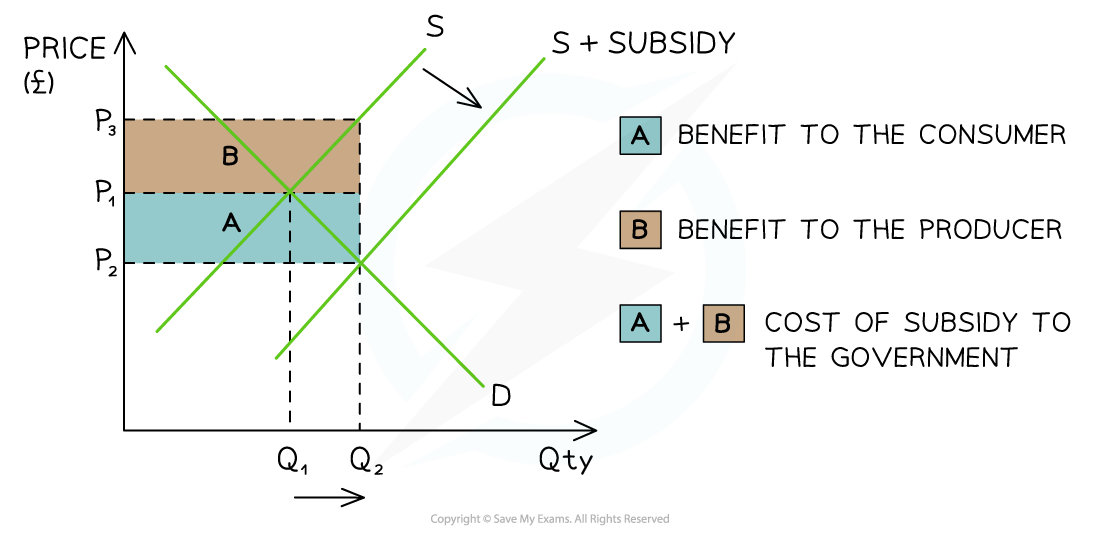
Diagram analysis
- The original equilibrium is at P1Q1
- The subsidy shifts the supply curve from S → S + subsidy:
- This increases the QD in the export market from Q1 → Q2
- The new market equilibrium is P2Q2
- This is a lower price and higher QD in the export market
Evaluating the use of subsidies to protect domestic firms
| Stakeholder | Explanation |
|---|---|
| Domestic producers | Subsidies reduce costs of production, allowing firms to produce more at lower pricesOutput increases, and firms become more competitive both domestically and internationally |
| Foreign producers | Face stronger competition from domestic firms with lower prices due to subsidiesMay lose market share and struggle to export to the subsidising country |
| Consumers | Benefit from lower prices, as subsidies help firms reduce selling pricesGreater affordability means consumers can buy more with their income |
| Government | Subsidies represent a cost to the government budgetThere is an opportunity cost — the money could be used for other public services like healthcare or education |
| Standards of living | Improves, especially for lower-income households, as goods become more affordable and jobs may be protected in supported industries |
| Equality | Subsidies help level the playing field for domestic firms competing with foreign producers who may have cost advantages or government support of their own |
3. Quotas
- A quota is a physical limit on imports e.g. in June 2022 the UK extended their quota on steel imports for a further two years in order to protect employment in the domestic steel industry
- This limit is usually set below the free market level of imports
- As cheaper imports are limited, a quota raises the market price
- As cheaper imports are limited, a quota may create shortages
- Some domestic firms benefit, as they are able to supply more due to the lower level of imports
- This may increase the level of employment for domestic firms
Evaluating the use of quotas to protect domestic firms
| Stakeholder | Explanation |
|---|---|
| Domestic producers | Able to increase output as they face less competition from importsHigher market prices raise their revenueMay lead to increased investment and job creation |
| Foreign producers | Face reduced access to the domestic market, lowering total outputHowever, those that do export under the quota can benefit from higher prices than under a tariff system |
| Consumers | Suffer from higher prices and reduced choiceReal income is affected by the increased cost of goods, lowering living standards |
| Government | Does not earn tariff revenue from the quota itselfMight gain some corporation tax later if domestic firms grow and report higher profits |
| Standards of living | Likely to fall for consumers, as more income is spent on fewer or more expensive goods |
| Equality | Helps domestic firms compete more fairly, especially if foreign producers are highly efficient or subsidised |
4. Embargoes
- An embargo is a complete ban on trade with a certain country, usually as the result of political fallout
- E.g. the USA ran an embargo for many decades on Cuban products
Evaluating the use of embargoes to protect domestic firms
| Stakeholder | Explanation |
|---|---|
| Domestic producers | Increases output due to less foreign competition |
| Foreign producers | They are unable to legally trade with the country running the embargoThey lose sales and profitsThey may go out of business or need to reduce their number of workers |
| Consumers | Prices will rise – and in some cases the product may no longer be available at all |
| Government | The government has to spend money enforcing the embargo |
Leave a Reply