6.1 Specialisation and free trade
6.1.1 Specialisation by country
- definition of specialisation by country
- the basis for specialisation by country in terms of the best resource allocation and/or low-cost
production - advantages and disadvantages of specialisation
- 6.1.2 Free trade
- definition of free trade
- advantages and disadvantages of free trade
6.1 Specialisation and free trade
6.1.1 Specialisation by country
- definition of specialisation by country
Specialisation is when a nation concentrates its productive efforts on producing a limited variety of goods and services in which they’re really efficient and productive at and have an advantage over other economies in.
For example, due to the existence of vast oil and gas reserves in the region, Middle-Eastern countries concentrate their production on petroleum and have made a fortune off of it.
- the basis for specialisation by country in terms of the best resource allocation and/or low-cost production
The basis for specialisation by country
- Specialisation occurs on several different levels
- On an individual level where a worker specialises in a particular task
- On a business level, e.g. one firm may only specialise in manufacturing drill bits for concrete work
- On a regional level e.g. Silicon Valley has specialised in the tech industry
- On a national level as countries seek to trade e.g. Bangladesh specialises in textiles and exports them to the world
Factors that allow a country to specialise?
1. Superior resource availability
- If the quality of the resource is relatively better than other nations, the country will be able to charge higher prices for it
- Alternatively, if a country has a higher quantity of the resource then it may be able to lower prices and drive competitors out of business by specialising in its extraction and sale
2. Cheaper production methods
- If the country has lower costs of production, then it is very likely that they will be able to lower selling prices and gain a lead in international market share
- Some countries are able to produce cheaply using machinery or technological innovation, whilst others do so by providing a large labour force, which can perform manual tasks very cheaply
advantages and disadvantages of specialisation
- Specialisation delivers incredible opportunities to countries, but it also has disadvantages that need to be recognised and protected against
| Advantages | Disadvantages |
|---|---|
| Efficient use of resources – countries focus on goods they can produce most effectively using their available land, labour and capital Greater output and lower average costs – specialisation often leads to economies of scale, where producing more reduces the cost per unit Encourages trade and variety – countries can export their specialised goods and import others, giving consumers more choice Improved international competitiveness – focusing on strengths helps countries produce higher-quality or lower-priced goods for global markets Boosts innovation and expertise – focusing on one industry encourages skill development and investment in new technology | Over-dependence on certain industries – if global demand falls or the sector declines, the whole economy may suffer Job losses in other sectors – industries that are not prioritised may shrink, causing unemployment in those areas Reduced self-sufficiency – countries may rely too heavily on imports for essential goods, such as food or medicine Exposure to global shocks – problems like wars, natural disasters, or trade bans can badly affect specialised economies Less flexibility in the future – if global demand changes, it may be hard for a country to adapt to a new industry quickly |
6.1.2 Free trade
definition of free trade
Free trade is when there are no restrictions for trade between economies.
advantages and disadvantages of free trade
The advantages of free trade
- Free trade is the exchange of goods and services between countries without any trade barriers, such as tariffs, quotas or import bans
- This means countries can buy and sell freely with each other, allowing for more open access to foreign markets
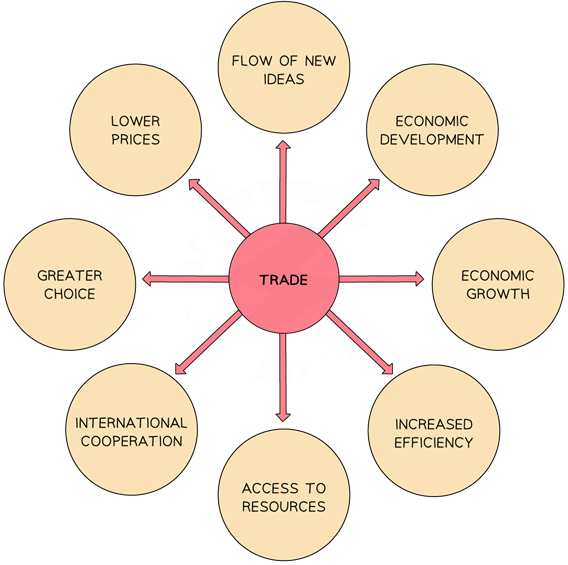
- Greater choice
- With access to a wider variety of goods/services, the standard of living improves
- Lower prices
- With international competition prices fall, giving households the ability to buy more
- International cooperation
- Required for trade, it helps countries to build better relationships, which leads to lower levels of hostilities
- Flow of new ideas
- Innovative ideas and technology can be shared between countries
- Access to resources
- Output can increase and costs of production can fall with increased access to raw materials
- Increased efficiency
- International competition allows the most efficient firms to emerge and this improves the use of global resources
- Economic growth
- Exports are a key component of the gross domestic product of many countries and an increase in exports can lead to economic growth
- Economic development
- Increased output leads to lower levels of unemployment, which leads to higher incomes and a higher standard of living
The disadvantages of free trade
- Harm to domestic industries
- Without protection from foreign competition, local firms may struggle to survive
- This can lead to business closures and job losses in certain sectors
- Over-dependence on imports
- Countries may rely too heavily on other nations for essential goods, such as food, fuel or medicine
- This can be risky if global supply chains are disrupted
- Job losses
- Free trade can lead to structural unemployment as less competitive industries shrink or shut down in the face of cheaper imports
- Worsening trade balance
- Some countries may import more than they export, leading to trade deficits which can create long-term economic problems
- Unequal gains
- While some countries and firms benefit, others may be left behind
- Smaller or less developed economies can find it hard to compete fairly
- Environmental damage
- Transporting goods across the world increases carbon emissions
- Also, some countries may ignore environmental standards to stay competitive
- Exploitation risks
- Firms may shift production to countries with lower wages and weaker labour laws, leading to poor working conditions and inequality
Leave a Reply