Overview
Introduction
A contract of sale creates reciprocal obligations: the seller must deliver goods and the buyer must pay the price agreed. When the buyer fails to pay or dishonours an instrument given in payment, the seller becomes an unpaid seller and acquires statutory rights under the Sale of Goods Act, 1930.
As per Section 45(1), a person is an unpaid seller in either of the following situations:
a. When the full price has not been paid or tendered and the seller has the immediate right to claim the price.
b. When a negotiable instrument (e.g., a bill of exchange, cheque) has been received as conditional payment and it is dishonoured or the condition is not fulfilled.
Section 45(2) expands the meaning of seller to include persons in the position of a seller, for example, a seller’s agent holding an endorsed bill of lading, a consignor, or an agent who has paid or is directly responsible for the price.
Example 1: If X sells goods to Y for ₹50,000 and Y pays only ₹40,000 leaving ₹10,000 unpaid, X is an unpaid seller.
Example 2: If P sells goods to R for ₹60,000 and accepts a cheque which is later dishonoured, P becomes an unpaid seller.
Question for Chapter Notes- Unit 4: Unpaid Seller
Try yourself:
In which situation is a seller considered an unpaid seller as per the Sale of Goods Act, 1930?
- A.When the buyer refuses to accept the goods.
- B.When the buyer fails to pay the full price for the goods.
- C.When the seller fails to deliver the goods on time.
- D.When the goods are damaged during transit.
Rights of an Unpaid Seller
Unpaid seller’s right (Section 46)
Subject to the provisions of the Act and any other law, an unpaid seller enjoys certain rights by operation of law even after the property in the goods has passed to the buyer. These rights aim to protect the seller’s interest in the price of the goods.
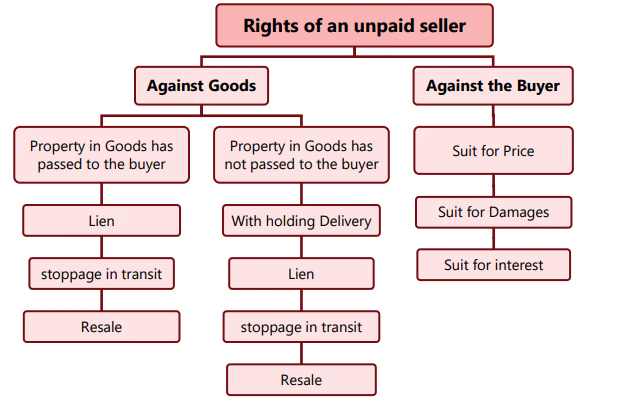
Principal rights of an unpaid seller
- A lien on the goods while in possession for the price.
- The right of stoppage in transit when the buyer becomes insolvent (after parting with possession).
- The right of resale subject to conditions in the Act.
- The right to withhold delivery (quasi-lien) where property has not passed to the buyer.
- Rights against the goods and personal remedies against the buyer (suits for price, damages, interest etc.).
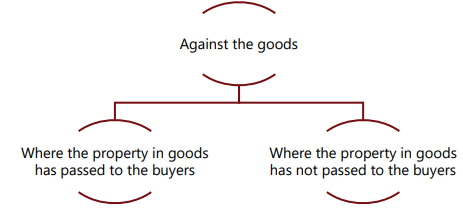
Rights of Unpaid Seller Against the Goods
1. Seller’s Lien (Section 47)
The seller’s lien is a possessory right to retain the goods until the price is paid or tendered. It applies only while the seller remains in possession of the goods.
When lien can be exercised
- When goods are sold on a cash sale (no credit terms).
- When goods are sold on credit and the agreed term has expired without payment.
- When the buyer becomes insolvent.
Example 3: A sells goods worth ₹50,000 to B on one-month credit. If B becomes insolvent during the period, A may exercise a lien on the goods.
The lien can be exercised even if the seller holds the goods merely as an agent or bailee for the buyer.
P sold certain antique items to Q for 3,00,000/- on 13.12.2024. As per the terms of agreement 75% of the amount was to be paid within a week and the balance 25% was to be paid till 31.12.2024. Q appointed his agent R to take delivery of the goods after payment of first installment. Q transferred a sum of 2,80,000/- in the account of P through NEFT on 18.12.2024 which was credited in P’s account on the same date. R failed to take delivery of antique items due to medical emergency. By the meantime, Q failed to make payment of the second installment till 31.12.2024. On 10.01.2025,
Q’s agent came to take the delivery of goods. But, P refused to deliver the goods and exercised his right of lien over the goods.
According to provisions of the Sale of Goods Act, 1930, give your opinion whether P was justified in exercising right of lien as only` 20,000/- was left to be paid? (4 Marks)
Ans: – Rights of lien (Section 47 of the Sale of Goods Act, 1930)
An unpaid seller has a right of lien on the goods for the price while he is in possession, until the payment or tender of the price of such goods. It is the right to retain the possession of the goods and refusal to deliver them to the buyer until the price due in respect of them is paid or tendered.
Exercise of right of lien: This right can be exercised by him in the following cases only:
(a) where goods have been sold without any stipulation of credit; (i.e., on cash sale)
(b) where goods have been sold on credit but the term of credit has expired; or
(c) where the buyer becomes insolvent.
In the instant case, P is still in possession of the goods and the full price was not paid by Q within the stipulated time i.e. till 31st December 2024. Therefore, P is an unpaid seller and can rightfully exercise lien under Section 47.
Even though the unpaid amount is only ` 20,000, P’s refusal to deliver the goods is valid. Thus, P is legally justified in exercising right of lien.
Mr. Shankar sold 1000 Kgs wheat to Mr. Ganesh on credit of 3 months. Wheat was to be delivered after 10 days of contract. After 5 days of contract, a friend of Mr. Shankar secretly informed him that Mr. Ganesh may default in payment. On the information of friend, Mr. Shankar applied the right to lien and withheld the delivery. With referring to the provisions of the Sale of Goods Act, 1930:
(i) State, whether Mr. Shankar was right in his decision?
(ii) What would be your answer if Mr. Ganesh became insolvent within five days of contract? (RTP June 24) (MTP May 25 Series 1)
Ans: –
According to Section 45(1) of the Sale of Goods Act, 1930 the seller of goods is deemed to be
an ‘Unpaid Seller’ when-
(a) The whole of the price has not been paid or tendered.
(b) A bill of exchange or other negotiable instrument was given as payment, but the same has been dishonoured, unless this payment was an absolute, and not a conditional payment.
Further, Section 47 provides about an unpaid seller’s right of lien. Accordingly, an unpaid seller can retain the possession of the goods and refusal to deliver them to the buyer until the price due in respect of them is paid or tendered. This right can be exercised by him in the following cases only:
(a) where goods have been sold without any stipulation of credit; (i.e., on cash sale)
(b) where goods have been sold on credit, but the term of credit has expired; or (c) where the buyer becomes insolvent.
In the instant case, Mr. Ganesh purchased 1000 Kg wheat from Mr. Shankar on 3 month’s credit which was to be delivered after 10 days of contract. But, after 5 days of contract, one friend of Mr. Shankar secretly informed him that Mr. Ganesh may default in payment. On the belief of friend, Mr. Shankar applied the right to lien and withheld the delivery.
(i) On the basis of above provisions and facts, it can be said that even Mr. Ganesh was an unpaid seller until the term of credit i.e. has expired, Mr. Shankar had to perform his promise of supplying 1000 Kg of wheat.
(ii) In case Mr. Ganesh became insolvent before the delivery of wheat, Mr. Shankar had the right to apply the lien and he could withhold the delivery.
A agrees to sell certain goods to B on a certain date on 10 days credit. The period of 10 days expired and goods were still in the possession of A. B has also not paid the price of the goods. B becomes insolvent. A refuses to deliver the goods to exercise his right of lien on the goods. Can he do so under the Sale of Goods Act, 1930? (Module Q) (MTP June 24 Series 1)
Ans: –
Lien is the right of a person to retain possession of the goods belonging to another until claim of the person in possession is satisfied. The unpaid seller has also right of lien over the goods for the price of the goods sold.
Section 47(1) of the Sales of Goods Act, 1930 provides that the unpaid seller who is in the possession of the goods is entitled to exercise right of lien in the following cases:-
- Where the goods have been sold without any stipulation as to credit
- Where the goods have been sold on credit but the term of credit has expired
- Where the buyer has become insolvent even though the period of credit has not yet expired.
In the given case, A has agreed to sell certain goods to B on a credit of 10 days. The period of 10 days has expired. B has neither paid the price of goods nor taken the possession of the goods. That means the goods are still physically in the possession of A, the seller. In the meantime B, the buyer has become insolvent. In this case, A is entitled to exercise the right of lien on the goods because the buyer has become insolvent and the term of credit has expired without any payment of price by the buyer.
Part delivery (Section 48). If the seller has made part delivery, he may exercise a lien on the remaining goods unless the circumstances of the part delivery indicate a waiver.
Termination of lien (Section 49). The seller loses his lien in the following situations:
- When he delivers the goods to a carrier or bailee for transmission to the buyer without reserving a right of disposal.
- When the buyer or his agent lawfully obtains possession of the goods.
- When the seller expressly or impliedly waives the lien.
- By estoppel, where seller’s conduct leads third parties to believe the lien has been waived.
Exception. Taking a decree for the price does not, by itself, extinguish the lien; the seller may still exercise it.
Example 4: A delivered a car to the railways for transmission to B and the railway receipt was in B’s name and sent to B. A cannot exercise lien after such delivery where the right to dispose was effectively given up.
Can an unpaid seller who has possession of goods exercise the Right of lien? If yes, mention such circumstances. When does he lose his right of line as per the provisions of the Sale of Goods Act, 1930? (6 Marks PYQ Dec 23)
OR
When can an unpaid seller of goods exercise his right of lien over the goods under the Sale of Goods Act? Can he exercise his right of lien even if the property in goods has passed to the buyer? When such a right is terminated? Can he exercise his right even after he has obtained a decree for the price of goods from the court? (Module Q)
Ans: –
A lien is a right to retain possession of goods until the payment of the price.
Seller’s lien (Section 47 of the Sale of Goods Act, 1930):
According to sub-section (1), the unpaid seller of goods who is in possession of them is entitled to retain possession of them until payment or tender of the price in the following cases, namely:-
(a) where the goods have been sold without any stipulation as to credit;
(b) where the goods have been sold on credit, but the term of credit has expired;
(c) where the buyer becomes insolvent.
According to sub-section (2), the seller may exercise his right of lien notwithstanding that he in possession of the goods as agent or bailee for the buyer.
As per the provisions of Section 48, where an unpaid seller has made part delivery of the goods, he may exercise his right of lien on the remainder, unless such part delivery has been made under such circumstances as to show an agreement to waive the lien.
Termination of lien (Section 49):
According to sub-section (1), the unpaid seller of goods loses his lien thereon-
(a) when he delivers the goods to a carrier or other bailee for the purpose of transmission to the buyer without reserving the right of disposal of the goods;
(b) when the buyer or his agent lawfully obtains possession of the goods;
(c) by waiver thereof.
The unpaid seller of goods, having a lien thereon, does not lose his lien by reason only that he has obtained a decree for the price of the goods. [Sub-section (2)]
Yes, he can exercise his right of lien even after he has obtained a decree for the price of goods from the court.
2. Right of Stoppage in Transit (Sections 50–52)
Meaning (Section 50). When the seller has parted with possession by delivering the goods to a carrier or bailee for transmission to the buyer and the buyer becomes insolvent, the unpaid seller may stop the goods in transit and regain possession until payment is made.
Conditions for exercising the right
- The seller must be an unpaid seller.
- The seller must have relinquished possession to a carrier or bailee.
- The goods must be in transit at the relevant time.
- The buyer must be insolvent.
Example 5: A in Mumbai sells goods to B in Delhi and entrusts them to C, a common carrier. If B becomes insolvent before delivery, A can notify C and stop the goods in transit.
Ravi sold 500 bags of wheat to Tushar. Each bag contains 50 Kilograms of wheat. Ravi sent 450 bags by road transport and Tushar himself took remaining 50 bags. Before Tushar receives delivery of 450 bags sent by road transport, he becomes bankrupt. Ravi being still unpaid, stops the bags in transit. The official receiver, on Tushar’s insolvency claims the bags. Decide the case with reference to the provisions of the Sale of Goods Act, 1930. (RTP Jan 25) (MTP June 24 Series 1)
Ans: –
Right of stoppage in transit (Section 50 of the Sale of Goods Act, 1930):
Subject to the provisions of this Act, when the buyer of goods becomes insolvent, the unpaid seller who has parted with the possession of the goods has the right of stopping them in transit, that is to say, he may resume possession of the goods as long as they are in the course of transit and may retain them until paid or tendered price of the goods.
When the unpaid seller has parted with the goods to a carrier and the buyer has become insolvent, he can exercise this right of asking the carrier to return the goods back, or not to deliver the goods to the buyer.
In the instant case, Tushar, the buyer becomes insolvent, and 450 bags are in transit. Ravi, the seller, can stop the goods in transit by giving a notice of it to Tushar. The official receiver, on Tushar’s insolvency cannot claim the bags.
Ram sells 200 bales of cloth to Shyam and sends 100 bales by lorry and 100 bales by Railway. Shyam receives delivery of 100 bales sent by lorry, but before he receives the delivery of the bales sent by railway, he becomes bankrupt. Can Ram exercise right of stopping the goods in transit? (Module Q) (MTP Jan 25 Series 2) (MTP June 24 Series 2)
Ans: –
Right of stoppage of goods in transit: The problem is based on Section 50 of the Sale of Goods Act, 1930 dealing with the right of stoppage of the goods in transit available to an unpaid seller. The section states that the right is exercisable by the seller only if the following conditions are fulfilled.
(i) The seller must be unpaid
(ii) He must have parted with the possession of goods
(iii) The goods must be in transit
(iv) The buyer must have become insolvent
(v) The right is subject to the provisions of the Act.
Applying the provisions to the given case, Ram being still unpaid, can stop the 100 bales of cloth sent by railway as these goods are still in transit. He may recover the price of other 100 bales sent by lorry by using his rights against the buyer
Duration of transit (Section 51). Goods are in transit from the time they are delivered to a carrier or bailee for transmission to the buyer until the buyer or his agent takes delivery from that carrier or bailee.
When transit ends (examples)
- Delivery to the buyer or to another bailee on behalf of the buyer.
- Buyer intercepts the goods before destination (with or without carrier’s consent).
- Carrier acknowledges to buyer or buyer’s agent that he is holding the goods (unless seller reserved the right of disposal).
- Goods delivered to a carrier hired by the buyer or to a ship chartered by the buyer.
- Partial delivery where transit ends for the delivered portion.
- Carrier wrongfully refuses to deliver to buyer (transit may end depending on circumstances).
Mode of stoppage (Section 52). The seller may stop goods in transit either by:
i. Taking actual possession from the carrier or bailee.
ii. Giving notice to the carrier or bailee in possession so as to prevent delivery to the buyer.
When notice is given to the principal (e.g., carrier’s principal), it must be communicated in time to prevent delivery to the buyer. The carrier then must re-deliver the goods according to the seller’s directions; expenses of re-delivery are borne by the seller.
Difference between Lien and Stoppage in Transit
- Right of Lien: Seller retains possession; can be invoked whether or not buyer is insolvent; ends when goods leave seller’s possession.
- Right of Stoppage in Transit: Seller has already parted with possession; goods are with a carrier; normally invoked when buyer becomes insolvent; begins when lien ends and ends on delivery to buyer.
Sub-sale or Pledge by Buyer (Section 53)
- The seller’s lien or stoppage in transit is not defeated merely because the buyer has sold or pledged the goods, unless the seller has agreed to such disposition.
- A subsequent buyer cannot generally obtain a better title than the original buyer had vis-à-vis the unpaid seller.
Example 6: A sells goods to B and hands them to the railways for transmission. B sells to C before receipt. If B becomes insolvent, A can still stop the goods in transit because he did not assent to the sub-sale.
Defeat of stoppage in transit. The right is defeated where the buyer transfers the document of title or pledges the goods to a third party who takes in good faith and for value. If the transfer is by way of sale, the right of stoppage is defeated. If, by way of pledge, the unpaid seller’s rights are subject to the pledgee’s rights.
Situations Where Seller’s Lien and Stoppage in Transit are Invalidated
- Seller’s assent to buyer’s disposition: If the seller has agreed to the buyer’s sale, mortgage or other disposition of the goods, seller’s lien/stoppage may be extinguished (see Mount D. F. Ltd. v. Jay & Jay (Provisions) Co. Ltd.).
- Transfer of document of title: If the document of title has been transferred by the buyer to a third party who buys in good faith and for consideration, the seller’s rights may be defeated.
- Effect of stoppage: Exercising stoppage in transit does not automatically rescind the contract; the buyer may still get delivery upon payment.
J sold a machine to K. K gave a cheque for the payment. The cheque was dishonoured.
But J handed over a delivery order to K. K sold the goods to R on the basis of the delivery order. J wanted to exercise his right of lien on the goods. Can he do so under the provisions of the Sale of Goods Act, 1930? (Module Q)
Ans: –
The right of lien and stoppage in transit are meant to protect the seller. These will not be affected even when the buyer has made a transaction of his own goods which were with the seller under lien. But under two exceptional cases these rights of the seller are affected:-
(i) When the buyer has made the transaction with the consent of the seller
(ii) When the buyer has made the transaction on the basis of documents of title such as bill of lading, railway receipt or a delivery order etc.
In the given case, J has sold the machine to K and K gave a cheque for the payment. But the cheque was dishonoured that means J, the seller is an unpaid seller. So, he is entitled to exercise the right of lien, but according to section 53(1) his right of lien is defeated because he has given the document of title to the buyer and the buyer has made a transaction of sale on the basis of this document. So, R who has purchased the machine from K can demand the delivery of the machine
A, who is an agent of a buyer, had obtained the goods from the Railway Authorities and loaded the goods on his truck. In the meantime, the Railway Authorities received a notice from B, the seller for stopping the goods in transit as the buyer has become insolvent. Referring to the provisions of Sale of Goods Act, 1930, decide whether the Railway Authorities can stop the goods in transit as instructed by the seller? (Module Q)
Ans: –
The right of stoppage of goods in transit means the right of stopping the goods after the seller has parted with the goods. Thereafter the seller regains the possession of the goods.
This right can be exercised by an unpaid seller when he has lost his right of lien over the goods because the goods are delivered to a carrier for the purpose of taking the goods to the buyer.
This right is available to the unpaid seller only when the buyer has become insolvent. The conditions necessary for exercising this right are:-
1 The buyer has not paid the total price to the seller
2 The seller has delivered the goods to a carrier thereby losing his right of lien
3 The buyer has become insolvent
4 The goods have not reached the buyer, they are in the course of transit. (Section 50, 51 and 52)
In the given case A, who is an agent of the buyer, had obtained the goods from the railway authorities and loaded the goods on his truck. After this the railway authorities received a notice from the seller B to stop the goods as the buyer had become insolvent.
According to the Sale of Goods Act, 1930, the railway authorities cannot stop the goods because the goods are not in transit. A who has loaded the goods on his truck is the agent of the buyer. That means railway authorities have given the possession of the goods to the buyer.
The transit comes to an end when the buyer or his agent takes the possession of the goods.
3. Right of Re-sale
The unpaid seller may resell the goods under certain conditions to mitigate loss when the buyer defaults.
Conditions for exercising the right of resale
(i) Where the goods are of a perishable nature
- If the goods are perishable, the seller need not give any notice of his intention to re-sell.
- He may immediately re-sell to prevent loss.
(ii) Where the seller gives notice of intention to re-sell and buyer still defaults
If the seller gives notice to the buyer that he intends to resell, and the buyer does not pay or tender the price within a reasonable time, the seller may resell the goods.
In this case, the seller can:
(a) Recover damagesRecover the difference between the contract price and resale price from the original buyer (if the resale price is lower).
(b) Retain profitIf the resale price is higher than the original contract price, the seller may keep the profit.
- The seller can recover the loss and retain the profit only when notice of resale is given to the buyer.
- If resale is done without notice, the seller cannot recover any loss from the original buyer.
- If resale leads to profit without notice, the profit must be returned to the original buyer (Section 54(2)).
(iii) Where an unpaid seller exercising lien or stoppage in transit resells the goods
If the seller resells while exercising lien or stoppage in transit, such resale gives a good title to the new buyer, even if notice of resale was not given to the original buyer.
(iv) Re-sale expressly reserved in the contract of sale
Sometimes the contract itself states that:
- If the buyer defaults in payment,
- The seller may re-sell the goods.
In such cases:
- Seller need not give notice of resale.
- Seller can recover damages from the original buyer even without notice.
(v) Where property in goods has not passed to the buyer
If the property has not yet passed to the buyer (as in an agreement to sell), the unpaid seller may:
- Withhold delivery,
- Exercise a right similar to lien, called a quasi-lien.
- This is an additional remedy available when the ownership has not transferred.
Which right of the unpaid seller allows them to retain possession of the goods until the price is paid or tendered by the buyer?
- A.Right of re-sale
- B.Right of stoppage in transit
- C.Right of lien
- D.Right of sub-sale
What are the rights of unpaid seller in context to re-sale the goods under Sale of Goods Act, 1930? (6 Marks PYQ Nov22) OR
Explain the concept of the “Right of Re-sale” under the Sale of Goods Act, 1930. Under what circumstances can an unpaid seller exercise this right? (MTP May 25 Series 2)
Ans: –
Right of re-sale [Section 54 of the Sale of Goods Act, 1930]: The right of resale is a very valuable right given to an unpaid seller. In the absence of this right, the unpaid seller’s other rights against the goods that is lien and the stoppage in transit would not have been of much use because these rights only entitled the unpaid seller to retain the goods until paid by the buyer.
The unpaid seller can exercise the right to re-sell the goods under the following conditions:
(i) Where the goods are of a perishable nature: In such a case, the buyer need not be informed of the intention of resale.
(ii) Where he gives notice to the buyer of his intention to re-sell the goods:
If after the receipt of such notice the buyer fails within a reasonable time to pay or tender the price, the seller may resell the goods.
It may be noted that in such cases, on the resale of the goods, the seller is also entitled to:
(a) Recover the difference between the contract price and resale price, from the original buyer, as damages.
(b) Retain the profit if the resale price is higher than the contract price.
It may also be noted that the seller can recover damages and retain the profits only when the goods are resold after giving the notice of resale to the buyer. Thus, if the goods are resold by the seller without giving any notice to the buyer, the seller cannot recover the loss suffered on resale. Moreover, if there is any profit on resale, he must return it to the original buyer, i.e. he cannot keep such surplus with him [Section 54(2)].
(iii) Where an unpaid seller who has exercised his right of lien or stoppage in transit resells the goods:
The subsequent buyer acquires the good title thereof as against the original buyer, despite the fact that the notice of re-sale has not been given by the seller to the original buyer.
(iv) A re-sale by the seller where a right of re-sale is expressly reserved in a contract of sale:
Sometimes, it is expressly agreed between the seller and the buyer that in case the buyer makes default in payment of the price, the seller will resell the goods to some other person.
In such cases, the seller is said to have reserved his right of resale, and he may resell the goods on buyer’s default.
It may be noted that in such cases, the seller is not required to give notice of resale. He is entitled to recover damages from the original buyer even if no notice of resale is given.
(v) Where the property in goods has not passed to the buyer:
The unpaid seller has in addition to his remedies a right of withholding delivery of the goods. This right is similar to lien and is called “quasi-lien”. This is the additional right used in case of agreement to sell.
Rights of Unpaid Seller Against the Buyer (Section 55-61)
The unpaid seller also has personal remedies (rights in personam) against the buyer in case of breach of the contract of sale. These include suing for the price, damages, interest and other reliefs.
1. Suit for Price (Section 55): If property in the goods has passed to the buyer and the buyer refuses to pay, the seller may sue for the price.
2. Suit for damages for non-acceptance (Section 56): If the buyer wrongfully neglects or refuses to accept and pay for the goods, the seller can sue for damages. The measure of damages is governed by Section 73 of the Contract Act.
3. Repudiation before due date (Section 60): If the buyer repudiates the contract before the time for delivery, the seller may treat the contract as rescinded and sue for damages – the rule of anticipatory breach applies.
4. Suit for interest (Section 61): Seller may recover interest where there is an agreement to pay interest, or the court may award interest where legally appropriate from the date payment became due or from the date of tender/notification.
Suraj sold his car to Sohan for 75,000. After inspection and satisfaction, Sohan paid 25,000 and took possession of the car and promised to pay the remaining amount within a month. Later on, Sohan refuses to give the remaining amount on the ground that the car was not in a good condition. Advise Suraj as to what remedy is available to him against Sohan. (Module Q) (RTP Sept 24)
Ans: –
As per the section 55 of the Sale of Goods Act, 1930 an unpaid seller has a right to institute a suit for price against the buyer personally. The said Section lays down that
(i) Where under a contract of sale the property in the goods has passed to buyer and the buyer wrongfully neglects or refuses to pay for the goods, the seller may sue him for the price of the goods [Section 55(1)].
(ii) Where under a contract of sale the price is payable on a certain day irrespective of delivery and the buyer wrongfully neglects or refuses to pay such price, the seller may sue him for the price. It makes no difference even if the property in the goods has not passed and the goods have not been appropriated to the contract [Section 55(2)].
This problem is based on above provisions. Hence, Suraj will succeed against Sohan for recovery of the remaining amount. Apart from this, Suraj is also entitled to:-
(1) Interest on the remaining amount
(2) Interest during the pendency of the suit.
(3) Costs of the proceedings
Mr. D sold some goods to Mr. E for 5,00,000 on 15 days credit. Mr. D delivered the goods. On due date, Mr. E refused to pay for it. State the position and rights of Mr. D as per the Sale of Goods Act, 1930. (Module Q)
Ans: -
Position of Mr. D:
Mr. D sold some goods to Mr. E for 5,00,000 on 15 days credit. Mr. D delivered the goods. On due date Mr. E refused to pay for it. So, Mr. D is an unpaid seller as according to Section 45(1) of the Sale of Goods Act, 1930 the seller of goods is deemed to be an ‘Unpaid Seller’ when the whole of the price has not been paid or tendered and the seller had an immediate right of action for the price.
Rights of Mr. D:
As the goods have parted away from Mr. D and already delivered to E, therefore, Mr. D cannot exercise the right against the goods, he can only exercise his rights against the buyer i.e. Mr. E which are as under:
(i) Suit for price (Section 55): In the mentioned contract of sale, the price is payable after 15 days and Mr. E refuses to pay such price, Mr. D may sue Mr. E for the price.
(ii) Suit for damages for non-acceptance (Section 56): Mr. D may sue Mr. E for damages for non-acceptance if Mr. E wrongfully neglects or refuses to accept and pay for the goods. As regards measure of damages, Section 73 of the Indian Contract Act, 1872 applies.
(iii) Suit for interest [Section 61]: If there is no specific agreement between Mr. D and Mr. E as to interest on the price of the goods from the date on which payment becomes due, Mr. D may charge interest on the price when it becomes due from such day as he may notify to Mr. E.
Remedies of Buyer Against the Seller
Breach of contract by the seller occurs where the seller:
- Fails to deliver the goods at the time or in the manner agreed.
- Repudiates the contract before the date of delivery.
- Delivers goods that do not conform to the contract (condition or warranty breaches).
Rights of buyer
- Claim damages for non-delivery (Section 57).
- Seek specific performance where goods are ascertained or specific and equity requires it (subject to the Specific Relief Act, 1963).
- Claim damages for breach of warranty (Section 59) – buyer cannot reject goods for mere breach of warranty but can claim damages or price reduction.
- Pursue remedies for anticipatory breach if the seller repudiates before the performance date.
1. Damages for non-delivery (Section 57). If the seller wrongfully neglects or refuses to deliver, the buyer may sue for the difference between the contract price and the market/resale price or other appropriate measure under the Contract Act.
Example 8: A agrees to sell 100 pairs of shoes to B at ₹10,500 per pair. B planned to resell to C at ₹11,000 per pair. A fails to deliver; B loses the resale profit. B can claim damages equal to ₹500 per pair (difference between resale and contract price), subject to proof.
Ansari of Jaipur sold 100 smart TV set @ 50,000/- per set to Baburam of Delhi. He delivered the TV sets to Chetan, a transport carrier for transmission to Baburam. Baburam further sold these 100 TV sets to Shayamlal @ 60,000/- per set. On reaching the goods at the destination, Baburam demanded the delivery but Chetan, wrongfully, refused to deliver the goods to Baburam. That is why; he failed to deliver TV sets to Shayamlal and suffered a huge loss on account of non-delivery. Ansari came to know about this. He directed Chetan to stop the delivery to Baburam and re-deliver the goods to him at Jaipur.
Answer the following questions under the provisions of the Sale of Goods Act, 1930:
(A) Whether Ansari has right to stop the goods in transit?
(B) Whether Baburam can claim loss suffered due to nondelivery from Ansari? (3 Marks PYQ Sept 24) (MTP Jan 25 Series 1)
Ans: –
According to Section 51 of the Sale of Goods Act, 1930, when the carrier wrongfully refuses to deliver the goods to buyer, the right of stoppage in transit is lost and transit comes to an end.
On the other hand, according to section 57 of the Sale of Goods Act, 1930, where buyer suffers losses due to non-delivery, he can sue seller for damages on account of non-delivery.
In the instant case, the transit came to an end when Chetan wrongfully refused to deliver the goods to Baburam, and he suffered a huge loss due to non- delivery. Hence, Ansari cannot exercise the right of stoppage of goods in transit as the transit has already come to an end.
Baburam can claim loss suffered due to non-delivery from Ansari
2. Suit for Specific Performance (Section 58)
- Buyer may seek specific performance where the goods are specific or ascertained, and damages are inadequate.
- Relief is granted subject to equitable principles and the provisions of the Specific Relief Act, 1963.
Example 9: If A agrees to sell a unique Mughal-period painting to B and then refuses to deliver, B can seek a decree for specific performance to compel delivery.
3. Suit for Breach of Warranty (Section 59)
- Where a warranty is breached, the buyer cannot reject the goods solely on that ground but can claim damages for breach of warranty.
- The buyer may take necessary actions as per the provisions of the law.
4. Repudiation of Contract Before Due Date (Section 60):
- When either party involved in a contract of sale repudiates the agreement before the delivery date, the other party has options.
- The aggrieved party can choose to keep the contract active and wait for delivery, or they may treat the contract as rescinded.
- If the contract is treated as rescinded, the aggrieved party can sue for damages resulting from the breach.
5. Suit for Interest
- The Act preserves the parties’ rights to claim interest and special damages where recoverable in law. Courts may award interest where appropriate in refund cases or where payment is delayed.
Example 10: If cigarettes sold are discovered to be mildewed and cannot be consumed, damages are calculated by comparing contract price and resale or market price.
Example 11: Where title has not passed or goods are not registered for transfer (depending on context), certain remedies for breaches of conditions and warranties may be limited.
What is the remedy available to the buyer if the seller wrongfully neglects or refuses to deliver the goods?
- A.Suit for damages for non-delivery
- B.Suit for specific performance
- C.Suit for breach of warranty
- D.Suit for interest
What are the rights of a buyer, when seller commits a breach of contract under the provisions of the Sale of Goods Act, 1930? (7 Marks) (PYQ Jan 25)
(MTP Sept 24 Series 1)
Ans: –
If the seller commits a breach of contract, the buyer gets the following rights against the seller:
Damages for non-delivery [Section 57 of the Sale of Goods Act, 1930]:
Where the seller wrongfully neglects or refuses to deliver the goods to the buyer, the buyer may sue the seller for damages for non-delivery.
Suit for specific performance (Section 58):
Where the seller commits breach of the contract of sale, the buyer can appeal to the court for specific performance. The court can order for specific performance only when the goods are ascertained or specific and where damages would not be an adequate remedy.
Suit for breach of warranty (Section 59):
Where there is breach of warranty on the part of the seller, or where the buyer elects to or is forced to treat breach of condition as breach of warranty, the buyer is not by reason only of such breach of warranty entitled to reject the goods on the basis of such breach of warranty; but the buyer may –
(i) set up against the seller the breach of warranty in diminution or extinction of the price; or
(ii) sue the seller for damages for breach of warranty.
Repudiation of contract before due date (Section 60):
Where either party to a contract of sale repudiates the contract before the date of delivery, the other may either treat the contract as:
subsisting and wait till the date of delivery, or
he may treat the contract as rescinded and sue for damages for the breach.
Suit for interest:
(1) The buyer is entitled to recover interest or special damages, or to recover the
money paid where the consideration for the payment of it has failed.
(2) In the absence of a contract to the contrary, the court may award interest at such rate as it thinks fit on the amount of the price to the buyer in a suit by him for the refnd of the price in a case of a breach of the contract on the part of the seller from the date on which the payment was made.
Auction Sale
Definition. An auction sale is conducted by inviting public bids; the property passes to the highest bidder when the auctioneer announces completion (commonly by the fall of the hammer). The auctioneer acts as agent for the seller unless otherwise stated.
Legal rules (Section 64)
a. Sale in lots: If goods are sold in lots, each lot is treated as a separate contract.
b. Completion of sale: Sale is complete when the auctioneer announces it; prior to that bidders may retract their bids.
c. Right to bid: Seller may reserve right to bid; if such right is not announced, seller should not bid directly or through an agent as that can be fraudulent.
d. Pretended bidding: Artificially increasing price by pretended bids by seller or agent makes the sale voidable by the buyer.
e. Reserved or upset price: Auction may be conducted subject to a reserved minimum price.
Example 12: P sold a car at auction to Q subject to cheque payment and an agreement that ownership transfers only when cheque clears. Q sells to R before cheque clears. Ownership passes at fall of hammer; R obtains valid title. Q and R have valid sales in their favour relative to third parties.
(ii) An auction takes place in Delhi for antique items. It is notified to the bidders that the sale will be completed, only when the hammer of the auctioneer hits the table and he announces “you are the highest bidder”. During the auction, L bids for an antique sculpture, worth ` 8 lakhs. The hammer falls, but announcement cannot be made as the auction suddenly stops before the auctioneer can utter any words. It is notified to everyone that there has been an unexpected rise in the market price for that particular sculpture, and therefore, it will not be sold on that particular day. L contends that the auctioneer is bound to sell the sculpture to him at the price he bid because once he bid at the highest price in the auction and the hammer fell, the auction sale was completed and therefore, the auctioneer is under a contractual obligation to sell the sculpture. The auctioneer disagrees. Discuss the validity of L’s claim in reference to the provisions of the Sale of Goods Act, 1930. (3 Marks) (PYQ May 25)
Ans. Legal Rules of Auction sale: Section 64 of the Sale of Goods Act, 1930 provides following rules to regulate the sale by auction:
Completion of the contract of sale: The sale is complete when the auctioneer announces its completion by the fall of hammer or in any other customary manner. Until such announcement is made, any bidder may retract from his bid.
In the instant case, the sale of sculpture to L is not complete as only hammer falls but the auctioneer did not announce “you are the highest bidder”.
Therefore, L’s claim contending that the auctioneer is bound to sell the sculpture to him at the price he bid is not valid as the auction sale was not complete.
An auction sale of the certain goods was held on 7th March, 2023 by the fall of hammer in favour of the highest bidder X. The payment of auction price was made on 8th March, 2023 followed by the delivery of goods on 10th March, 2023. Based upon on the provisions of the Sale of Goods Act, 1930, decide when the auction sale is complete. (2 Marks PYQ June 23) (MTP Sept 24 Series 2)
Ans: –
According to Section 64 of the Sale of Goods Act, 1930, the sale is complete when the auctioneer announces its completion by the fall of hammer or in any other customary manner.
In the given question, the auction sale is complete on 7th March, 2023
PTC Hotels in Bombay decided to sell their furniture by auction sale. For this purpose, they appointed RN & Associates as auctioneer. They invited top ten renowned Architects in Bombay for bidding. A right to bid was not notified by them. Furniture was put up in lots for sale. It was decided that for every lot of furniture there will be a reserve price. On 25th Feb 2024, Auction sale was started at 10.am in the lawn of PTC Hotels Bombay. For a special lot of furniture three parties came for bidding Mr. Neel, Mr. Raj and Mr. Dev on behalf of their respective companies. Bidding was as follows:
Mr. Neel 5.70 lakh Mr. Raj 4.85 lakh Mr. Dev6.10 lakh
The sale was completed in favour of Mr. Neel by RN & Associates by fall of hammer. Mr. Dev's Bid was rejected on ground that Right to bid was reserved and company of Mr. Dev was not invited to bid. For another bid of Italian Furniture was made by two parties as follows: Mr. Dheer 15 lakh Mr. Madhu (on behalf of R N & Associates) ` 15.20 lakh
Sale was completed in favour of Mr. Dheer instead of Mr. Madhu.
Mr. Dev and Mr. Madhu argued that auction sale was not lawful. Give your opinion with reference to provisions of the Sale of Goods Act, 1930 whether Auction Sale will be considered lawful or not? (7 Marks PYQ June 24)
Ans: –
An ‘Auction Sale’ is a mode of selling property by inviting bids publicly and the property is sold to the highest bidder. Section 64 of the Sale of Goods Act, 1930 regulates the legal requirements for the sale by auction.
In terms of the provisions of the above Section, following are some of the requirements, which inter alia are required to be complied with for conduct of a valid auction sale-
(i) Where the goods are sold in lots:
Where the goods are put up for sale in lots, each lot is prima facie deemed to be subject of a separate contract of sale.
(ii) Right to bid may be reserved:
Right to bid may be reserved expressly by or on behalf of the seller and where such a right is expressly reserved, but not otherwise, the seller or any one person on his behalf may bid at the auction.
(iii) Where the sale is not notified by the seller:
Where the sale is not notified to be subject to a right to bid on behalf of the seller, it shall not be lawful for the seller to bid himself or to employ any person to bid at such sale, or for the auctioneer knowingly to take any bid from the seller or any such person; and any sale contravening this rule may be treated as fraudulent by the buyer.
(iv) Reserved price:
The sale may be notified to be subject to a reserve or upset price;
In the first Auction sale, the rejection of Mr. Dev’s bidding was not justified since the information as to the right to bid was not expressly given. Therefore, this auction sale was unlawful.
In auction sale of lot 2, since right to bid was not notified, it shall not be lawful for the seller to bid himself or to employ any person to bid at such sale. Therefore, auction made in favour of Mr. Dheer will be considered lawful.
Explain the legal rules of auction sale relating to the following points as per provisions of the Sale of Goods Act, 1930:
(A) Bid by seller with or without notification
(B) Bidder to retract from his bid
(C) Effect of pretending bidding (4 Marks PYQ Sept 24) (RTP May 25)
Ans: –
Section 64 of the Sale of Goods Act, 1930 provides following rules to regulate the sale by auction:
(A) Bid with notification: Right to bid may be reserved expressly by or on behalf of the seller and where such a right is expressly reserved, but not otherwise, the seller or any one person on his behalf may bid at the auction.
Bid by seller without notification: Where the sale is not notified to be subject to a right to bid on behalf of the seller, it shall not be lawful for the seller to bid himself or to employ any person to bid at such sale, or for the auctioneer knowingly to take any bid from the seller or any such person; and any sale contravening this rule may be treated as fraudulent by the buyer.
(B) Bidder to retract from his bid: The sale is complete when the auctioneer announces its completion by the fall of hammer or in any other customary manner. Until such announcement is made, any bidder may retract from his bid.
(C) Effect of pretending bidding: If the seller makes use of pretended bidding to raise the price, the sale is voidable at the option of the buyer.
Rachit arranges an auction to sale an antic wall clock. Deepa, being one of the bidders, gives the highest bid. For announcing the completion of sale, the auctioneer falls the hammer on table but suddenly hammer brakes and damages the watch. Deepa wants to avoid the contract. Can she do so under the provisions of the Sale of Goods Act, 1930? (Module Q) (MTP June 24 Series 3) (RTP Sept 25)
Ans: –
By virtue of provisions of Section 64 of the Sale of Goods Act, 1930, in case of auction sale, the sale is complete when the auctioneer announces its completion by the fall of the hammer or in some other customary manner.
In the instant case, Deepa gives the highest bid in the auction for the sale of an antique wall clock arranged by Rachit. While announcing the completion of sale by fall of hammer on the table, hammer brakes and damages the clock.
On the basis of the above provisions, it can be concluded that the sale by auction cannot be completed until hammer comes in its normal position after falling on table. Hence, in the given problem, sale is not completed. Deepa will not be liable for loss and can avoid the contract
Inclusions of Increased or Decreased Taxes in a Contract of Sale (Section 64A)
When a contract is made and a tax (such as customs, excise, sales tax or any duty) is imposed, increased, decreased, remitted or altered after the contract but before its performance, the price may be adjusted accordingly unless the parties have expressly agreed otherwise.
Key points
- If taxes are increased after the contract and before performance, the buyer must pay the increased tax component unless the contract says otherwise.
- If taxes are decreased, the buyer benefits from the reduction in price.
- Examples of applicable taxes include duties of customs or excise and taxes on sale or purchase of goods.
- Parties are free to exclude this statutory rule by express agreement in the contract.
Leave a Reply