Overview
Stipulation as to Time (Section 11)
- Time for Payment: In a contract of sale, unless the contract expressly specifies otherwise, stipulations as to the time for payment are not treated as essential conditions. The parties may agree a time for payment, but absent such agreement the law does not automatically treat time as vital.
- Delivery of Goods: Unless the contract provides otherwise, delivery should be made without unreasonable delay. Whether the time of delivery is an essential stipulation depends on the terms agreed by the parties.
- Price: The price under a contract may be fixed by the contract or left to be fixed in a manner agreed by the parties. If the price is to be fixed later by a third party or according to a specified method, that method governs.
- Time of Delivery: Stipulations as to the time of delivery may be essential (conditions) or non‑essential (warranties), depending on the expressed intention or the nature of the contract.
Introduction to Conditions and Warranties
- When a seller makes statements to induce a buyer to purchase, those statements usually concern the quality, description, nature and fitness of goods.
- If such statements are not incorporated into the contract, they do not form part of the contractual obligations. If they are incorporated and relied upon by the buyer, they operate as contractual stipulations.
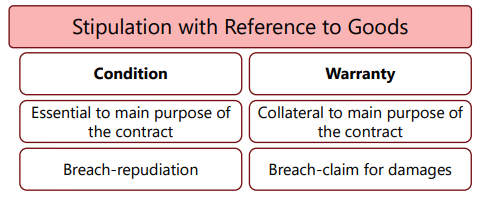
- A stipulation that forms part of a contract and affects the parties’ obligations is called a stipulation. Stipulations differ in importance: the more important are called conditions, and the less important are called warranties.
Section 12provides the statutory definitions:
Condition: A stipulation essential to the main purpose of the contract. Breach of a condition entitles the aggrieved party to treat the contract as repudiated (i.e., to reject the goods and/or rescind the contract) and to claim damages.
Example 1: If P buys a car from Q on the basis that it gives 20 km/litre but later finds it gives only 15 km/litre, the mileage claim is a stipulation affecting the main purpose of the contract; its breach may amount to a breach of condition.
Warranty: A stipulation collateral to the main purpose of the contract. Breach of a warranty entitles the aggrieved party to claim damages but not to reject the goods or repudiate the contract.
Example 2: Ram asks Shyam, a dealer, for a vehicle suitable for touring, and Shyam recommends a Maruti. If the vehicle proves unsuitable for touring, the stipulation as to suitability is a condition and Ram may reject the car and claim a refund.
Differences between Conditions and Warranties
Warranty
- Meaning: A warranty is a stipulation collateral to the main object of the contract.
- Remedy for Breach: Breach of warranty gives rise only to a claim for damages; it does not entitle the buyer to reject the goods or treat the contract as terminated.
- Conversion: A breach of warranty cannot be treated as a breach of condition (except in particular circumstances where parties agree or where statute permits).
Condition
- Meaning: A condition is a stipulation essential to the main purpose of the contract.
- Remedy for Breach: Breach of condition entitles the aggrieved party to repudiate the contract, claim damages, or both.
- Conversion: In some situations a breach of condition may be treated as breach of warranty (see Section 13 and related rules).
When a Condition is Treated as a Warranty (Section 13)
Section 13 identifies situations where, although a stipulation is in form a condition, the buyer cannot avoid the contract on account of its breach and instead is confined to a claim for damages – in effect treating the condition as a warranty. The following are principal cases:
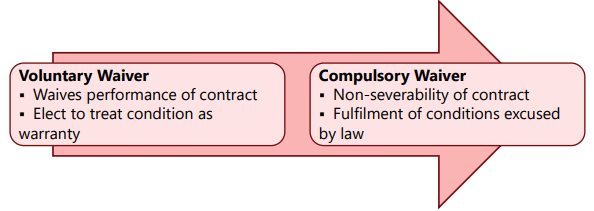
(i) Waiver of Condition by Buyer:A buyer can waive the performance of a condition for their own benefit, provided it is a voluntary waiver.
(ii) Election to Treat Breach as Warranty: The buyer can choose to treat a breach of condition as a breach of warranty, claiming only damages instead of repudiating the contract.
Example 3: If a supplier delivers second quality sugar instead of first quality, the buyer can reject the goods for breach of condition. However, if the buyer decides to accept the second quality sugar and claim damages, they are treating the breach as a warranty.
(iii) Non-Severable Contracts: If the contract is non-severable and the buyer has accepted either the whole goods or any part thereof, the breach of condition does not void the contract.
(iv) Excuse of Condition or Warranty by Law: If the fulfillment of any condition or warranty is excused by law due to impossibility or other reasons, the breach does not void the contract.
Example 4: If second‑quality sugar is delivered when first quality was contracted for, the buyer can reject the goods for breach of condition; but if the buyer chooses to accept them and claim damages, the buyer has treated the breach as a warranty.
Waiver of Conditions
Express and Implied Conditions and Warranties (Sections 14–17)
Conditions and warranties may be express (specifically agreed between parties and recorded in the contract) or implied (read into the contract by law, trade usage or course of dealing). 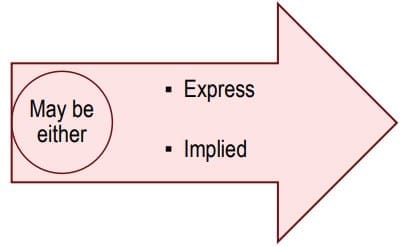
Implied Conditions in a Contract of Sale
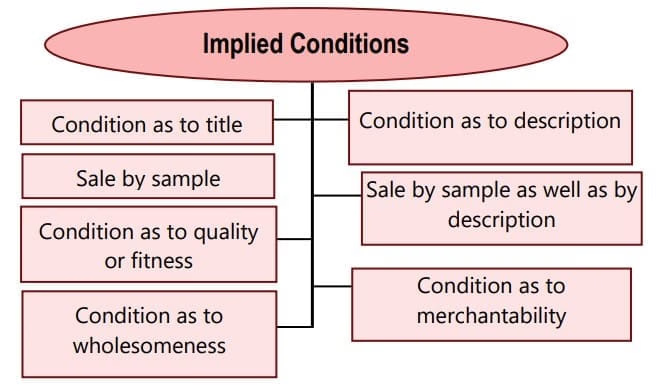
- Condition as to Title (Section 14): Unless otherwise agreed, the seller warrants that they have the right to sell the goods. In a sale, the seller must have the right to transfer property immediately; in an agreement to sell, the seller must have that right at the time when property is to pass.
- Condition as to Description (Section 13–15 interplay): Where goods are sold by description, there is an implied condition that the goods will correspond with that description.
- Sale by Sample (Section 15): Where goods are sold by sample, there is an implied condition that the bulk shall correspond with the sample, and that the buyer shall have a reasonable opportunity of comparing the bulk with the sample.
- Condition as to Quality or Fitness (Section 16): If the buyer, expressly or by implication, makes known the particular purpose for which the goods are required and relies on the seller’s skill or judgment, and the seller deals in goods of that description, there is an implied condition that the goods are reasonably fit for that purpose.
- Condition as to Merchantability (Section 16): Where goods are bought by description from a seller who deals in goods of that description, there is an implied condition that the goods shall be of merchantable quality, except where defects would be apparent on a reasonable examination by the buyer.
(i) Condition as to Title
- Right to Sell: The seller must have the right to transfer ownership unless the contract says otherwise.
- Transfer of Ownership: The seller must be in a position to transfer a good title when ownership is to pass.
- Defective Title: If the seller has no title or the title is defective, the buyer who has to restore the goods to the true owner may recover the purchase price from the seller.
Examples: A buys a tractor from B who had no title; when the true owner claims the tractor A must deliver it and can sue B for the price. If A buys tins labelled with a registered trade mark that infringes a third party’s rights, the buyer may reject the goods or claim damages for the reduced value.
(ii) Sale by Description
- Implied Condition: Goods sold by description must correspond with that description. The buyer is entitled to reject goods that do not conform.
- Breach of Condition: If the description was a fundamental term of the agreement, non‑conformity is a breach of condition, allowing rejection even if the buyer had the opportunity to inspect.
- Definition of Description: The Act does not define ‘description’ exhaustively; it may include class, kind, origin, shipment particulars, specifications, etc., depending on the contract and factual matrix.
Examples: Merchandise sold as “waste silk” must conform to that standard; a ship sold as “copper‑fastened” but only partially copper‑fastened does not meet the description.
(iii) Sale by Sample
- Correspondence with Sample: The bulk must correspond with the sample in quality.
- Opportunity for Comparison: The buyer must be given a reasonable opportunity to compare the bulk with the sample.
Example: If a buyer inspects only a smaller parcel of wheat but not the larger and the larger fails to match the smaller, the buyer may be entitled to refuse acceptance of the bulk.
(iv) Sale by Sample and Description (Section 15)
- Where goods are sold both by sample and by description, the goods must correspond with both the sample and the description. If they correspond with one but not the other, the buyer can repudiate the contract.
Example: Goods equal to sample but containing an undeclared mixture contrary to the description – the buyer may reject.
(v) Condition as to Quality or Fitness
- If the buyer notifies the seller of the particular purpose and relies on the seller’s skill or judgment, and the seller is in the business of supplying such goods, there is an implied condition that the goods will be fit for that purpose.
- If the buyer relies solely on a trade name or brand rather than the seller’s skill, the implied condition may not arise.
Example: A dentist supplying false teeth that do not fit – the buyer can reject; if a buyer requests a particular brand by name and relies on the brand, the implied condition of fitness based on the seller’s skill may not apply.
(vi) Condition as to Merchantability
- When goods are bought by description from a seller who deals in such goods, there is an implied condition that the goods are of merchantable quality.
- The buyer should examine the goods before purchase; defects that ought to have been discovered by such an examination will not give rise to a claim under this implied condition.
Examples: A manufacturer supplying scratched, damaged horns can be rejected as unmerchantable; goods damaged by white ants breach merchantability.
(vii) Condition to Wholesomeness (Eatables)
- For foodstuffs and provisions, an implied condition of wholesomeness applies in addition to merchantability.
Example: If milk supplied contains typhoid germs and causes death, the supplier is liable for breach of condition as to fitness wholesomeness.
Implied Warranties in Contracts
Implied warranties arise by operation of law and are part of every contract of sale unless expressly excluded. They can also be displaced by the course of dealing or trade usage (see Section 62 of the Sale of Goods Act).
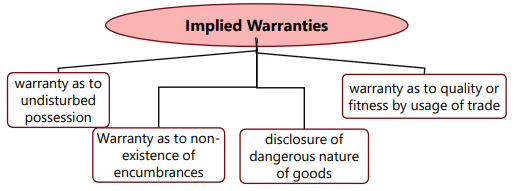
- Warranty of Undisturbed Possession (Section 14/15 implications): The seller warrants that the buyer shall have and enjoy quiet possession of the goods. If later, the buyer’s possession is disturbed by a third party claiming title, the seller may be liable for breach of warranty.
Example: if a laptop bought turns out to be stolen, the buyer may sue the seller.
- Warranty as to Non‑existence of Encumbrances: The seller warrants that the goods are free from undisclosed charges or encumbrances known to the seller but unknown to the buyer.
Example: if a car sold was pledged to a lender and the pledge was not disclosed, the buyer has recourse against the seller.
- Warranty on Quality or Fitness (Section 16(3)): Implied warranties related to quality and fitness may arise from trade usage or customs. The general rule is caveat emptor (let the buyer beware), subject to statutory and recognised exceptions.
- Disclosure of Dangerous Goods: If goods are inherently dangerous and the buyer is unaware, the seller must disclose the danger. Failure to warn where a duty to warn exists can give rise to liability for damages.
Caveat Emptor
- Meaning: “Caveat emptor” means “let the buyer beware”. When goods are offered in the open market, the buyer is expected to exercise reasonable care in selection.
- If purchased goods are found defective, in the absence of an applicable implied term or misrepresentation, the buyer cannot hold the seller liable for defects discoverable by reasonable examination.
- The seller is not generally bound to disclose defects; the buyer must satisfy themselves that goods meet intended purposes before purchase.
- Section 16 reinforces the principle that there is no implied warranty as to quality or fitness unless the conditions for an implied warranty are satisfied (e.g., reliance on seller’s skill, purchase by description, trade usage, etc.).
For a buyer to hold a seller accountable under the exceptions to Caveat Emptor, the following conditions are typically necessary:
- The buyer must have communicated the particular purpose for which the goods are required.
- The buyer must have relied on the seller’s skill or judgment in selecting the goods.
- The seller must be in the business of supplying goods of that description (i.e., the seller deals in such goods).
Example: A sold pigs infected with disease to B; the court held that the rule of caveat emptor applied and the seller was not bound to disclose their unfitness unless an exception applied.
Example: A buys a horse for riding but does not inform the seller of that intended use; the horse turns out unsuitable for riding though fit for driving. Caveat emptor applies: A cannot reject the horse or claim damages.
Exceptions to the Doctrine of Caveat Emptor
- Fitness as to quality or use (Section 16(1)): If the buyer makes known the specific purpose and relies on the seller’s skill, and the seller is in the business of supplying such goods, the seller must supply goods reasonably fit for that purpose.
- Specific Purpose: If an item is suitable only for a single purpose, the buyer need not specifically inform the seller of that purpose for the implied condition to apply. If an item has multiple uses, the buyer must specify the intended use.
- Goods Purchased Under Patent or Brand Name: If goods are bought by brand or patent, the buyer is deemed to rely on the brand reputation rather than the seller’s skill; the implied condition as to fitness may not apply.
- Goods Sold by Description (Section 15): If goods are sold by description, they must correspond to that description; the buyer may reject non‑conforming goods.
- Merchantable Quality: When goods are bought by description from a seller who deals in goods of that description, they must be of merchantable quality; hidden defects not discoverable by reasonable examination remain the seller’s liability.
- Sale by Sample: Where goods are sold by sample, caveat emptor does not protect the seller if the bulk does not correspond to the sample.
- Trade Usage: An implied warranty or condition may arise from trade usage; the seller is bound by established trade practices and customs where relevant.
- Seller’s Misrepresentation or Concealment: If the seller misrepresents facts or actively conceals defects which the buyer could not discover by reasonable inspection, the buyer may rescind the contract and claim damages.
- Case Illustrations: A retail chemist affirming that a hot‑water bottle could safely contain boiling water – where that assurance induced the purchase and the bottle proved unsafe – the seller was liable in damages (case law consistent with the fitness exception).
Leave a Reply