The Sale of Goods Act, 1930
Unit 1: Formation of the Contract of Sale
Overview
Introduction
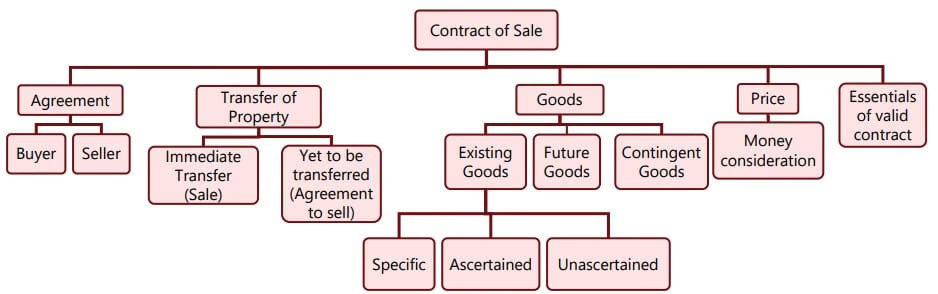
The Sale of Goods Act, 1930, regulates contracts for the sale of goods in India. The Act was enacted because a separate statute was required to deal specifically with the sale of goods; previously, such provisions were included in the Indian Contract Act, 1872. The Act is based on the English Sale of Goods Act, 1893, and came into force on 1 July 1930, applying throughout India.
Scope of the Act
- The Act applies to contracts involving the sale of movable property (goods).
- It does not apply to the sale of immovable property (land, buildings); such matters are governed by the Transfer of Property Act, 1882.
- The Act relates only to movable property.
- The general provisions of the Indian Contract Act, 1872, remain applicable to contracts of sale unless they conflict with the Sale of Goods Act.
- Terms used in the Sale of Goods Act that are not defined in it but are defined in the Indian Contract Act take the meanings assigned in the Contract Act.
- Customs and usages that are reasonable and known to both parties at the time of making the contract bind both parties.
Definitions in the Sale of Goods Act, 1930
A. Buyer and Seller
- Buyer: A person who buys, or agrees to buy, goods.
- Seller: A person who sells, or agrees to sell, goods.
- These definitions include persons who merely agree to buy or agree to sell; the terms are therefore used in a broad sense.
Relationship between Buyer and Seller
- The terms describe the two parties to a contract of sale: the seller (transferor) and the buyer (transferee).
- A person who merely agrees to buy (but has not yet taken delivery) is still a buyer for the Act; similarly for a seller.
B. Goods and Related Terms
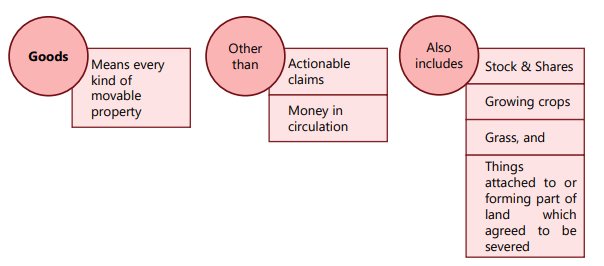
- Goods: Means every kind of movable property other than actionable claims and money. Section 2(7) expands this to include stock and shares, growing crops, grass, and things attached to or forming part of the land that are agreed to be severed before sale.
- Actionable claims: Claims that can be enforced by action (for example, debts). Generally, actionable claims are excluded from the definition of goods, but some instruments (e.g., Fixed Deposit Receipts) may be treated as goods under certain circumstances.
- Goods include both tangible and certain intangible items such as goodwill, copyrights, patents and trademarks, where the contract treats them as goods; items like gas, steam, water and electricity have also been treated as goods in particular contexts.
Classification of Goods
Existing Goods
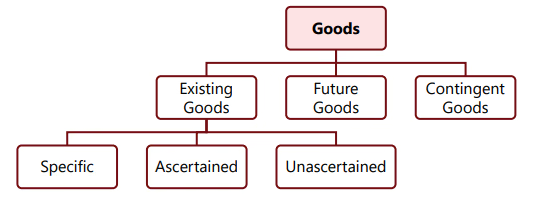
- Existing goods are those which are owned or possessed by the seller at the time of the contract.
- Existing goods can be classified as specific, ascertained or unascertained.
(a) Specific Goods
- Specific goods are identified and agreed upon at the time the contract is made.
- Example 1: Selling a particular car (e.g., A’s Santro) agreed between A and B is a sale of specific goods.
- Example 2: A particular model of a smartphone or a specified washing machine is sold by description that identifies the exact item.
(b) Ascertained Goods
- Ascertained goods are those identified after the contract is made in accordance with the contract (often used interchangeably with specific goods once identified).
- Example 3: A wholesaler selling 50 bales out of 100 in his warehouse; once the 50 bales are selected, they become ascertained goods.
(c) Unascertained Goods
- Unascertained goods are not identified or selected at the time of contracting; they are described only by description, quantity or sample.
- Example 4: Selling one packet of salt out of a hundred without specifying which packet. Once a particular packet is appropriated to the contract, it becomes ascertained or specific.
- Example 5: Contract to sell one of ten horses without specifying which horse – this is a contract for unascertained goods until the horse is identified.
Future Goods
- Future goods are goods to be manufactured or acquired by the seller after the contract is made (Section 2(6)).
- A contract for future goods is always an agreement to sell, not a sale, because the seller cannot transfer ownership of goods that do not yet exist.
- Example 6: A agrees to sell 1,000 quintals of potatoes to be grown next season – this is a contract for future goods.
- Examples 7 & 8: P agrees to sell Q all milk his cow will produce next year; T agrees to sell S all oranges to be harvested this year – both are contracts for future goods.
Contingent Goods
- Contingent goods are goods the acquisition of which by the seller depends on the happening of an uncertain event.
- As with future goods, contingent goods give rise to an agreement to sell rather than an immediate sale.
- Example 9: A agrees to sell B a painting only if A can buy it first – the painting is contingent.
- Example 10: P contracts to sell 50 pieces of goods contingent on the safe arrival of the ship carrying them – the contract is conditional on that contingency.
C. Delivery and Its Forms

- Actual delivery: Physical handing over of goods to the buyer or to a person authorised by the buyer. This is the common form of delivery.
- Constructive delivery: Occurs without a change in physical custody. Delivery by attornment is an example – the person in possession acknowledges holding the goods on behalf of the buyer.
- Example 11: A warehouseman holding goods of A agrees to hold them on behalf of B at A’s request – this is constructive delivery by attornment.
- Symbolic delivery: Delivery by symbol (for example, handing over the keys of a warehouse where the goods are stored).
Condition of Goods for Delivery
- Goods are in a deliverable state when they are in such a condition that the buyer is bound to accept them under the contract (Section 2(3)).
- Example 12: If A contracts to sell timber to B and agrees to make bundles before delivery, the goods are in a deliverable state only after bundling is completed.
D. Documents of Title to Goods
- A document of title to goods is a document such as a bill of lading, dock warrant, warehouse-keeper’s certificate, wharfinger’s certificate, railway receipt, warrant or order for delivery which evidences the right to possession of goods and enables the transfer of that right by delivery or endorsement.
- Example 13: Bill of lading, dock warrant, warehouse keeper’s certificate, railway receipt, etc., are documents of title. A mate’s receipt is not a document of title as it merely acknowledges receipt of goods.
- A share certificate may show title to shares, but it is not a document of title to goods because it does not enable transfer of possession by endorsement and delivery.
E. Mercantile Agent
- A mercantile agent is an agent who, in the ordinary course of business, has authority to sell goods, to consign goods or to buy goods, or to raise money on the security of goods (Section 2(9)).
- Example 14: Auctioneers, brokers and other commercial agents who deal with goods in the ordinary course of business are mercantile.
F. Property in Goods [Section 2(11)]
- Property in goods means general ownership in the goods – the seller must transfer, or agree to transfer, general property in the goods to the buyer.
- This relates to ownership rights (not merely special rights such as a pledgee’s interest).
- Example 15: If A (owner) pledges goods to B for an advance, A retains general property while B has a special interest to the extent of the advance; on default, B may sell the goods under the rights of a pledgee.
G. Price [Section 2(10)]
- Price is the monetary consideration for the sale of goods; the price must be expressed in money for a contract to be a sale of goods.
H. Quality of Goods [Section 2(12)]
- Quality includes the state or condition of the goods and any requirement as to their fitness, description or other attributes relevant to the contract.
I. Insolvency [Section 2(8)]
- A person is said to be insolvent when he ceases to pay his debts in the ordinary course of business or cannot pay his debts as they become due.
Sale and Agreement to Sell (Section 4)
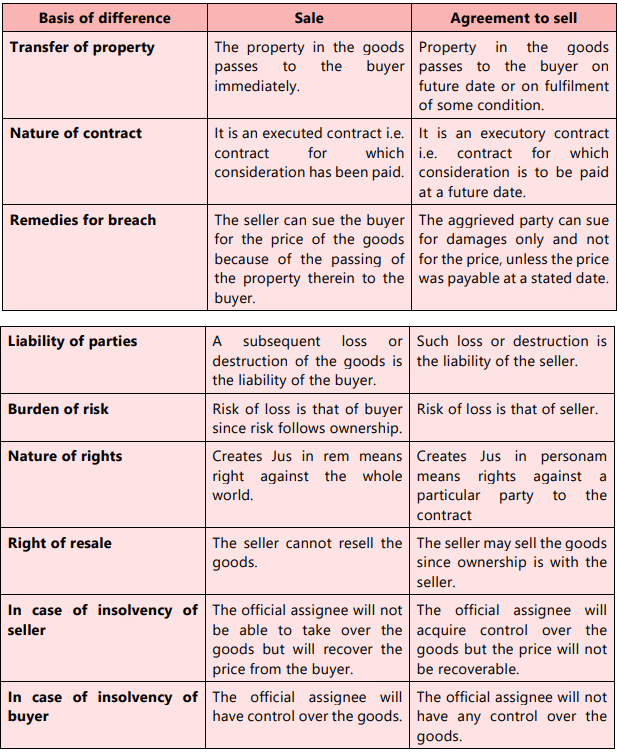
Agreement to sell: Where the transfer of property in the goods is to take place at a future time or is subject to some condition to be fulfilled, it is called an agreement to sell (Section 4(3)).
Whether a contract of sale is an absolute sale or an agreement to sell depends on whether the transfer of ownership is to take place immediately or at a future time.
Example 16: X agrees with Y on 10 October 2022 that he will sell his car to Y on 10 November 2022 for ₹7,00,000 – this is an agreement to sell.
When an agreement to sell becomes a sale: An agreement to sell becomes a sale when the time elapses or the condition is fulfilled so that property in the goods passes to the buyer.
Essential Elements of a Contract of Sale of Goods
- Parties: There must be at least two parties – a seller and a buyer. One person cannot be both seller and buyer in the same contract.
- Subject-matter: The subject matter must be goods (existing, future or contingent goods as permitted by the Act).
- Price: The price must be in money (wholly or partly); the contract must involve monetary consideration.
- Other essentials: All other essentials of a valid contract must be present – free consent, capacity to contract, lawful object and consideration.
Distinction Between Sale and Agreement to Sell
The distinction depends on the time of transfer of property and consequent rights and liabilities.
Sale Distinguished from Other Contracts
(i) Sale and Hire-Purchase
- Sale: Ownership transfers to the buyer immediately on sale.
- Hire-purchase: Goods are hired with an option to purchase; ownership passes according to the terms (often on payment of last instalment or according to the hire-purchase agreement).
- Legal incidents differ: in sale the buyer acquires rights immediately, but in hire-purchase the hirer may have use but not ownership till conditions are met.
- Risk and insolvency implications differ depending on the contract terms.
(ii) Sale and Bailment
A bailment is the delivery of goods by one person (the bailor) to another (the bailee) for a specific purpose under a contract, with the goods to be returned once the purpose is accomplished.
- Bailment involves a transfer of possession only (special property or custody), whereas sale involves transfer of general property (ownership).
- Return of goods is obligatory in bailment once the purpose is fulfilled; in sale goods need not be returned – ownership has passed.
- Consideration in sale is usually money; bailment may be gratuitous or for reward.
(iii) Sale vs. Contract for Work and Labour
- A contract of sale is essentially for the transfer of goods for a price.
- If the contract primarily concerns the exercise of skill or labour on goods supplied by the owner (for example, gold supplied to a goldsmith to be transformed), the contract is one for work and labour rather than a contract of sale.
- Example 17: Gold supplied to a goldsmith to make an ornament or an artist contracted to paint a picture – the dominant object is labour and skill, not the sale of goods.
Contract of Sale: How Made (Section 5)
- A contract of sale may be made in various ways: by express offer and acceptance, by immediate delivery, by agreement to deliver at a future date, in instalments, by barter with an agreed cash difference, and other recognised modes of forming contracts.
- Example: R agrees to exchange his old motorcycle (valued at ₹55,000) with S for a new motorcycle plus cash difference – this constitutes a contract of sale (a barter with cash adjustment).
Subject-Matter of a Contract of Sale
Existing or Future Goods (Section 6)
- Goods in a contract may be existing goods (owned or possessed by the seller) or future goods (to be manufactured or acquired by the seller later).
- A contract to sell goods to be manufactured by a specified mill or to be acquired later can be valid; such contracts are treated as contingent contracts when performance depends on future events.
- Example 19: Contract to buy cloth to be manufactured by a certain mill is valid subject to performance by that mill; these are contingent contracts.
- A present sale of goods that do not yet exist operates in substance as an agreement to sell until the goods come into existence and are appropriated.
Goods Perishing Before Contract (Section 7)
- If specific goods perish without the knowledge of the seller at or before the time when the contract is made so that they no longer correspond with the description in the contract, the contract is void.
- Example 20: A agrees to sell B 50 bags of wheat stored in A’s warehouse but the bags are destroyed by water damage unknown to both parties at the time of agreement – the contract is void.
Goods Perishing Before Sale But After Agreement (Section 8)
- If there is an agreement to sell specific goods and they perish or are damaged without fault of either party before the risk has passed to the buyer, the agreement becomes void.
- This happens when goods no longer exist in the form described in the agreement prior to transfer of risk.
Perishing of Future Goods
- If future goods which are specifically to be produced or acquired cannot be produced or acquired owing to supervening impossibility (for example, disease destroying the crop), the contract becomes void by reason of impossibility.
- Example 21: A agrees to sell B 100 tons of tomatoes to be grown next year, but disease destroys most of the crop so only 80 tons can be delivered – the contract may be frustrated or void to the extent performance is impossible.
Ascertainment of Price (Sections 9 & 10)
Ascertainment of Price (Section 9)
- The price in a contract of sale may be fixed by the contract itself.
- The price may be agreed to be fixed in a particular manner (for example, by a valuer) as provided by the contract.
- The price may be determined according to a course of dealing between the parties.
Agreement to Sell at Valuation (Section 10)
- Where the price is to be fixed by a third party (valuer or umpire), Section 10 governs consequences if that third party fails or refuses to fix the price.
- If the third party fails to fix the price due to default of one party, that party is liable for damages to the other.
- If the third party fails to fix the price for reasons not attributable to either party, the agreement becomes void unless the parties have provided an alternative method to determine price.
- If the buyer has already received and appropriated the goods, he must pay a reasonable price for them even if a third party fails to fix the contract price.
- Example 22: P agrees to sell two bikes to S at a price to be fixed by Q. If Q refuses to fix the price, S must pay a reasonable price for any bike already delivered; the contract with respect to undelivered goods may be void depending on circumstances.
Leave a Reply